Author: Dianedelgadolemaire
PMI signals expansion for first time since Dec. ’14 via www.houston.org
YES!!!!!
The Houston Purchasing Managers Index (PMI), a short-term leading indicator for regional production, registered 51.1 in October, signaling economic expansion in metro Houston for the first month since December ’14, according to the latest report from the Institute for Supply Management-Houston (ISM-Houston). The PMI has risen steadily since June, last registering 48.5 in September.
Click to access Purchasing_Managers_Index.pdf
Trading Company: Back Office Operations Analyst – dlemaire@cfstaffing.com
Overview:
Nominate and monitor operational activities on the assigned pipelines and gathering systems. Scope includes managing operational balancing points and meeting industry deadlines. Monitor and manage imbalances, taking corrective actions when required to minimize financial exposure to the business.
Review bulletin boards and communicate items relevant to the business. Stay current of industry news via publications and professional networking activities.
Develop and maintain strong working relationships with the assigned regional pipelines, gathering systems, producers and end-users.
Assist Back Office and counterparties in reconciliation efforts of pipeline imbalances and invoicing discrepancies. Scope includes proving all necessary reports and statement which support billing and payment activities.
Assist other internal groups as requested. Scope includes providing all necessary reports and statements supporting relevant operational activities.
Contribute to the development, implementation and continuous improvement of an effective internal control system. Carry out operational activities in accordance with internal policies and procedures and all applicable local, state and federal laws and regulation.
Participate in weekend and holiday on-call rotation. Scope includes monitoring operational activities and communicating with counterparties, pipelines, gathering systems and internal staff as required.
Requirements:
Undergraduate degree in economics, finance,engineering, accounting or general business
1 plus years of experience in Oil & Gas (settlements, LNG, scheduling, pipeline, gathering systems)
Small Company Controller – Humble, Texas
Our client is looking for a Controller to become the future leader of the Accounting & Finance team. We are looking for an experienced, small to mid size company Controller, with aspirations of being the CFO some day. The ideal candidate will be a natural leader, who truly cares about mentoring and training their staff. The company is located in Humble and has amazing tenure! There are approximately 10 people in Accounting, but this Controller will also be involved in Operations, IT, Credit and HR. A CPA is required for this role. The company is always looking towards the future and just launched their E commerce website.
Overview:
Month end and annual financial statements
Quarterly reporting
Review Journal Entries
General ledger account analysis and reconciliations
Company budget
Work property tax consultants, insurance companies and CPA firm.
Prepare monthly sales tax reports
Inventory Accounting
Required:
CPA
Manufacturing / Distribution background
Public Accounting preferred
15 plus years of experience
Great benefits! Competitive Pay! Family oriented corporate culture.
Houston Economic Update via Greater Houston Partnership – Better Times Ahead????
Click to access Economy_at_a_Glance.pdf
Better Times Ahead? — The worst may be over for the energy industry. The price of crude has more than doubled from its February trough. The North American drilling fleet has added more than 150 rigs over the past five months. Announcements of layoffs in the oil patch are less frequent. And bellwether companies, like Halliburton and Schlumberger, reported profits―albeit small ones―in the third quarter.
But other sectors of Houston’s economy continue to struggle. Construction has tapered off. Retail sales have slipped. Vehicle purchases are at their lowest level in five years. Sales tax collections trail last year’s pace. Fewer passengers are flying out of Bush Intercontinental Airport. And million-dollar homes go unsold in The Woodlands.
Continue reading: http://www.houston.org/pdf/research/quickview/Economy_at_a_Glance.pdf
Age: The Houston-The Woodlands-Sugar Land metro area has one of the youngest populations among its peers. The median age in Houston is 34.1 years. That means that half of all residents are younger and half are older than 34.1 years. The median age for the nation as a whole is 37.8 years. Houston’s young population translates into a large supply of entry-level and earlycareer workers to meet local hiring needs, a substantial base of consumers entering their household formation and wealth-acquisition years, and a larger population more open to social change.
Age, Part II: Senior citizens represent a smaller share of Houston’s population. Only one in 10 Houston residents is over the age of 65 compared to one in seven in San Francisco, New York and Boston, and one in five in Tampa. Seniors are less likely to be in the workforce, thus less likely to contribute to the region’s economic growth. They also tend to have lower incomes, make fewer purchases, pay lower taxes, and place greater demands on infrastructure, social services and health care.
Educational Attainment: Though Houston has made progress in recent years, the region’s educational attainment lags behind that of its peers. When corporations consider a city for a relocation or major capital investment, a well-educated workforce is as important as a low cost of doing business and well-developed infrastructure. The Texas Workforce Commission recently forecast Houston-area employment will add 700,000 jobs between ’14 and ’24, with roughly one-third of the newly created jobs requiring a high-school diploma and slightly more than one-third requiring education beyond high school. However, the lack of a welleducated workforce could result in occupational shortages and inhibit the region’s growth.
Race: Houston’s racial profile is the most diverse of the major metros. While San Francisco has a large Asian community, few blacks live in the metro area. While Miami has a large Hispanic population, the metro has few Asians. In Minneapolis, whites still account for more than three-fourths of all residents. Houston’s ethnic diversity has long been a strength for the region, providing cultural, business and civic opportunities not available in less diverse metros.
Employment Outlook Brightens — The Houston metro area added 14,500 jobs in September, according to the Texas Workforce Commission (TWC). While the reported job growth is a bit above historic patterns, it’s not substantially higher. Over the past 25 years, September job gains have ranged from 5,000 to 18,000, averaging 10,000. The average of the past five years is 13,100. In the 12 months ending September ’16, the region has created 20,100 jobs. The data suggest that the low point of the current downturn occurred May ’16, when the region’s 12-month gain was just 3,200 jobs. Not once in the recent downturn has the 12-month change been negative.
The bulk of the September growth (18,800 jobs) occurred in local public education, a subsector of local government. Over the past 10 years, local education has added an average of 16,500 jobs in the month. Given Houston’s recent population growth and the current stage of the business cycle—public education always lags every other sector by a year or two— September’s robust job growth is not surprising.
Houston benefited from the 1,600 jobs added in health care in September. That sector continues to generate employment opportunities. As long as people continue to move here, have babies here, and grow old here, that sector should continue to add jobs.
Construction also added 1,600 jobs in September, but growth in the sector will taper off in the coming months as the office, multi-family and chemical plant construction booms wind down.
The loss of only 300 jobs in manufacturing, a sector that cut 2,000 to 3,000 jobs a month in ’15 and early ’16, suggests the worst may be over for manufacturing.
Job losses in wholesale, retail trade, finance, insurance, real estate, and other services partly offset gains in the other sectors.
Retail always loses jobs in September before adding them back in October, November and December. The weakness in wholesale is symptomatic of the weakness in the energy sector and energy-related manufacturing.
The drop in finance employment is part of ongoing restructuring as the industry tries to remain profitable in a low-interest environment. The losses in accommodation and food services are no surprise. Like retail, the sector always loses jobs in September before adding them back over the remainder of the year.
Internal Auditor – Westchase – dlemaire@cfstaffing.com
Responsibilities:
- The Internal Auditor will review and evaluate the control environment and develop specific analyses of strengths and weaknesses, along with recommended improvements.
- Conduct audits covering strategic, financial, operational and compliance risks, including identifying issues, reviewing and analyzing findings, and documenting business processes and procedures.
- Responsible for all Inventory Management auditing.
- Responsible for Procedural Compliance audits.
- Will summarize and present audit findings to Executive level Leadership group.
- Identify audit issues, use root cause analyses and make recommendations using independent judgment and risk assessment.
- Consult with management on risks, controls and best practices.
- The objective is to find viable solutions for elimination/mitigation of losses through identification of weaknesses, recommendation of solutions and providing guidance to ensure success.
Primary Requirements:
- Bachelor’s Degree in Business, Financial or similar field, required.
- Certifications: CPA, CFE, CIA or like designation, preferred.
- A minimum of two (2) years of audit experience, required.
- Proven success/experience in financial loss investigations, fraud, and collusion or like forensic audits/assessments.
Staff and Senior Investment Analyst
Description of Job Duties:
- Assist in the monitoring of existing managers of the public and private investments portfolios.
- Prepare reports for the routine review of asset class level performance.
- Assist in the screening and due diligence process for new managers.
- Document the manager due diligence process.
- Assist with the development of and maintenance of asset class models and databases.
- Participate in investment research projects from asset allocation to security level review.
- Assist in the preparation of materials for quarterly board meetings.
- Complete other duties as assigned.
Education Required: Bachelor’s Degree. MBA or CFA designation is a plus.
Experience Required: 2 plus years of experience preferably at an investment firm, investment bank, or consulting firm.
7 psychological tricks to help you nail your job interview Article originally published on Business Insider
When it comes to job interviews, how you act can make as much of a difference as what you say.
While interviewers consciously take note of the answers you provide, your body language reveals subconscious clues to your personality and attitude.
So how do you ensure that your body language is giving off the right vibes? A Quora thread discussed just that, answering the question: “What are some great psychology tips, tricks, and techniques that I can use during a job interview that will increase my chances of getting any job?”
We rounded up the best responses to help you nail your next job interview. Here are seven psychological tricks to amp up your chances:
1. Warm up
“When you get there early, go to the bathroom and warm your hands, either under hot water or under a hand dryer,” suggests Susan Bearry. “Dry, warm hands inspire confidence. Cold, clammy hands are a big unconscious turn-off.” Putting yourself in the right mindset from the start will calm your nerves and help you focus.
2. Mirror their movements
Mirroring your interviewer’s hand gestures and breathing subtly shows them you’re on the same page, says Quora user Zambelli Sylar Federico. But remember, it’s more understated than flat-out copying their every move, which would likely come across as creepy. “They scratch their nose with left hand, you touch your face with right hand. They cross their legs, you cross legs the opposite way,” Federico explains.
3. Take your time
You might feel compelled to answer each question right away, but don’t be afraid to take a few seconds to collect your thoughts. Not only will your answer sound more articulate, but you’ll sound more confident to your interviewer. “It communicates to people that you know your own value. The vibe is that of someone who knows that what they have to say is worth the extra wait,” Tim Chi says.
4. Watch your body language
A nervous habit, such as cracking your knuckles or playing with your pen, can give the wrong impression to your interviewer. For example, avoid crossing your arms. “This gives off the vibe that you’re closing in on yourself and not willing to understand,” warns Melinda Edwards. Similarly, don’t fidget too much. “This makes the interviewer uncomfortable, because they see how restless you are,” she adds.
5. Bond with your interviewer
Finding common ground with your interviewer creates a personal connection that makes you more memorable and likeable. “Subtly compliment your interviewer on the questions he or she asks, or on some aspect of their personality,” Susan Bearry says. “Try to find something that will bond you, such as commenting on pictures of his or her family, or sports teams.”
6. Visualize your ideal interview
John Sannicandro recommends picturing yourself nailing the interview starting a few days beforehand. “Rehearse how you want to feel emotionally during the interview and get into that resourceful state many times during the days before,” he says. “You will be better able to tap into that state when it counts.” For example, if your nerves cause you to blurt out the first answer you think of, visualize yourself giving calm, composed responses — it will help you get into that mindset on the big day.
7. Read facial cues
Your interviwer’s body language can provide valuable feedback to how the interview is going if you learn to read it correctly. For example, if they lock eyes with you, they’re probably expecting you to elaborate more, says Quora user Abhishek A. Singh. Picking up on these nuances will help you tailor your responses to keep the interview on track.
Have questions about your job search or interviews? We want to hear them! Comment below or contact one of our expert recruiters today! Find the closes CFS location to you here.
Read the original article published on Business Insider.
Operations / Accounting / IT Analyst – Houston – dlemaire@cfstaffing.com
The Operations Analyst will support field operations and perform duties associated with operational accounting, primarily related to the payroll/billing/ticketing system and purchase order tracking. The Operations Analyst will also perform professional level human resources work.
JOB FUNCTIONS
- Verify and maintain weekly billing/payroll/ticketing system in Excel as it transitions into TMW
- Verify and maintain weekly payroll/time entry spreadsheet and email HR for weekly payroll
- Process purchase orders for equipment orders, which includes ensuring proper approval
- Maintain our preventative maintenance program, PMExpert
- Prepare invoices and distribute for approvals to customers
- Become a super-user of new billing/payroll/ticketing system that is currently being implemented (TMW) – assist in implementation, as needed
- Update/add new drivers, leases and contracts into TMW as needed
- Manage the employee on-boarding process, including preparing new hire paperwork, scheduling drug screens, completing background checks, sending notifications, etc.
- Assist with the development; implementation and testing of processes and controls to ensure continued SOX compliance
REQUIREMENTS
- Bachelor’s degree preferred, or an equivalent combination of education and work experience
- Experience administering an integrated billing/payroll/ticketing system
- Proficient use of Microsoft Office programs
Accounting Manager Or Senior Accountant – College Station, Texas
| $70,000.00 – $85,000.00 |
| Senior Financial Accountant If you enjoy personal development, teamwork, work life balance, and plenty of time off….(YES, it all can exist within an Accounting Position) look no further! This is an opportunity of a lifetime to join a stable and growing organization with a fantastic mission that YOU can be a part of! The culture of this organization is like none other. They truly care about their employees and have a “family first” mentality. They go above and beyond to ensure their people are well taken care of. Their core values include: Integrity, Trustworthiness, Honesty, Confidentiality, Acceptance, Joyfulness, Loyalty & Service. This organization truly lives and works according to their values. If you are a TOP Performer and wish to be with an organization that rewards your performance, look no further! This organization works not only with their clients to bring out the best in each and every individual to optimize organizational performance, but also with internal employees! As a top performer, I am sure you are interested in professional and personal development. With my client company, you will be coached and mentored to becoming the best employee, friend, family member, and individual you can be! Overview of the Senior Financial Accountant or Accounting Manager: Responsibilities/Duties for the Senior Financial Accountant or Accounting Manager:
Education and Experience Required for the Senior Financial Accountant or Accounting Manager: The Senior Financial Accountant will have a Bachelor’s degree in business or accounting with a minimum of 3 years of public accounting experience in audit or 5 years experience in industry preparing financial statements with responsibility for monthly close process and financial review.
Abilities:
|
Greater Houston Partnership – Employment UPDATE
Click to access Employment_Update.pdf
The Houston metro area added 14,500 jobs in September, according to data released today by the Texas Workforce Commission (TWC). While the reported job growth is a bit above historic patterns, it’s not unreasonably higher. Over the past 25 years, September job gains have ranged from 5,000 to 18,000, with an average of 10,000. The average of the last five years is 13,100.
The bulk of the growth (18,800 jobs) occurred in local education, a subsector of local government. Over the past 10 years, local education has added an average of 16,500 jobs in the month. Given Houston’s recent population growth and the current stage of the business cycle—public education always lags every other sector by a year or two—September’s robust job growth is not surprising.
Houston benefited from the 1,600 jobs added in health care in September. That sector continues to generate employment opportunities. As long as people continue to move here, have babies here, and grow old here, that sector will continue to add jobs.
Construction also added 1,600 jobs in September, but growth in the sector will likely taper off in the coming months as the office, multi-family and chemical plant construction booms wind down.
The loss of only 300 jobs in manufacturing, a sector that cut 2,000 – 3,000 jobs a month in ’15 and early ’16, suggests the worst may be over for manufacturing.
Job losses in wholesale, retail trade, finance, insurance, real estate, and other services partially offset gains in the other sectors. Retail always loses jobs in September before adding them back in October, November and December. The weakness in wholesale is symptomatic of the weakness in the energy sector and energy-related manufacturing. The drop in finance employment is part of on-going restructuring as the industry tries to remain profitable in a lowinterest environment.
The losses in accommodations and food services are no surprise. Like retail, the sector always loses jobs in September before adding them back over the remainder of the year. A common misconception is that TWC’s employment data reflect full-time/40-hour-a-week jobs. In reality, the data only reflect individuals on payroll, whether they work 20, 40 or 60 hours in a week. The employment loss in accommodations and food services may reflect the departure of part-time help, primarily high school and college students, who leave the payroll when they return to school in the fall.
Employment growth in accommodations and food services has been strong over the past 12 months, greatly exceeding the long-term trend for the sector. TWC may have overestimated this growth and the data may be revised downward when the agency issues its benchmark revisions in March 2017. Likewise, TWC reports that mining and logging added 200 jobs in September. This is a bit of a conundrum since the two subsectors that comprise 98.5 percent of employment in the mining and logging—exploration and production and oil field services—lost a combined 1,000 jobs in the month.
September’s energy employment numbers will likely be sorted out with the March benchmark revisions as well. Houston’s unemployment rate dropped from 5.8 in August to 5.7 percent in September. The Texas rate dropped from 5.0 to 4.9 percent. The U.S. rate decreased from 5.0 to 4.8 percent. The rates are not seasonally adjusted.
Greater Houston Partnership: Building Permit Update
Click to access COH_Building_Permits.pdf
City of Houston building permits totaled $440.6 million in September ’16, down 26.4 percent from $598.4 million in September ’15, according to the latest data released by the City’s Department of Public Works & Engineering Planning & Development Services.
Year-to-date, city building permits totaled $5.3 billion, down 12.8 percent from $6.1 billion over the same period in ’15.
For the 12 months ending September ’16, city building permits totaled $7.4 billion, down 5.3 percent from $7.9 billion in the 12 months ending September ’15.
Permits were down over-the-year across both residential and commercial sectors in September. The value of non-residential building permits fell 25.1 percent, from $435.5 million in September ’15 to $326.3 million in September ’16. Residential building permits declined 29.8 percent, from $163.0 million in September ’15 to $114.4 million in September ’16.
Within the residential sector, permits for single-family homes decreased 15.4 percent to $80.7 million in September ’16, while multi-family permits dropped 70.1 percent to $13.2 million.
Friday Fun

5 keys to composing an impactful resume Article originally published on US News & World Report
Try this exercise with a friend or loved one:
Give the other person your resume, but limit their reading time to six seconds and instruct them to show you how much they were able to assimilate in that limited time.
Why six seconds? Because that’s the amount of eyeball time your resume typically receives when it’s being first reviewed by human resources staffers or hiring authorities. If you can’t convey something that grabs their attention, chances are strong they won’t hesitate to hit the “delete” button and end your chances of being considered, no matter how well-qualified you might be.
This fact should influence the decisions you make about the overall look and feel of your resume. How you organize your information, what you choose to include, your choice of words and graphic elements all should contribute to a clear and coherent message that can be grasped in six seconds. Even a simple line across the page can facilitate a reader’s understanding or detract from it, depending on how it is used.
Here are some things you should strive for when creating your resume.
Readability
Make certain that even at a distance, your page looks inviting to read and that it is easy to follow the various sections, such as Skills, Professional Experience, Education, etc. Using color to highlight the section titles can make a difference in this regard.
Is there enough white space on the page to avoid looking like a solid blob of ink?
Have pity on people with poor eyesight by not going any lower than 10-point type. Use standard, easy-to-read fonts like Calibri or Optima, or others with similar weighting.
Audience accessibility
It is likely that within your target company, a variety of types of people with diverse backgrounds and roles will be reading your resume. For example, HR, financial and technical professionals all may weigh in on a resume’s value. It is important that the document speak to each of them in ways that they can appreciate and value.
Especially if you are in a field with its own particular vocabulary that is unknown to non-specialists, make sure you do your best to explain things in a way that can be commonly understood. When you list obscure tools or techniques that you are accustomed to using, take pains to also convey what results or accomplishments you attained by using them.
Present your personal brand
It might be that your resume surfaces because it came up in a sourcer’s search as possessing the right keywords. Congratulations! But now, as they begin to read it, a succinct and well-crafted branding statement at the top can truly set your document apart from others using the same keywords. In the top few lines, just under your name and contact information, it is essential that you give a “helicopter view” of yourself, conveying your essential qualities, areas of expertise and specific content that only you can offer the employer. Keep it to no more than four or five lines, tops!
Get rid of ambiguities
A resume recently reviewed by your author had this line: “Devised solutions that produced the desired results.” Lines like this convey no real information and leave questions about the candidate’s ability to communicate clearly.
When asked, “What were the problems requiring solutions? What kind of solutions did you develop? What were the desired results and how were they achieved?” the response was: “I’ll get into that when I have an interview.”
Sadly, ambiguous statements like these are counterproductive to getting the desired interview, and are likely to sink one’s chances of getting to the point of explaining their exceptional skills and talents.
Avoid stock phrases and clichés
Expunge what you think a resume “has to have” if you believe stock phrases like “aggressive go-getter,” “results driven,” or “excellent communication skills” are necessary. You’ll immediately generate a yawn or a grunt on the part of your resume reader.
They’ve seen all these and more countless times! Instead, utilize clearly thought out phrases and sentences that demonstrate the results your “go-getter” qualities generated, thereby communicating effectively.
Have questions about your job search? We want to hear them! Comment below or contact one of our expert recruiters today! Find the closes CFS location to you here.
Read the original article published on US News & World Report.
Posted by Creative Financial Staffing at 11:49 AM
Email ThisBlogThis!Share to TwitterShare to FacebookShare to Pinterest
Senior Financial Analyst – dlemaire@cfstaffing.com
- 9/80 work schedule
- 3 Weeks PTO + 8 Holidays
- 10% 401K match
SUMMARY
Senior Financial Reporting Analyst prepares the Company’s internal and external financial statements and the related disclosures, and provides technical support on selected accounting and disclosure matters in accordance with US GAAP and management reporting requirements.
RESPONSIBILITIES
- Internal Reporting : Manage the timely and accurate delivery of monthly Management reporting package, including:
- Prepare and review financial statements and related schedules to be included in the monthly financial reporting package.
- Compile and review monthly and quarterly variance analysis to explain significant variances in financial statement accounts, utilizing input from the respective account owners in the Accounting department.
- External Reporting : Manage the timely and accurate delivery of quarterly and annual accounting reports and financial statements under US GAAP for reporting to investors and debt holders, including:
- Prepare and review financial statement schedules
- Draft supporting tables/schedules to Notes to Financial Statements and update disclosures based on authoritative accounting guidance.
- Coordinate with other departments to obtain required information for the Notes to Financial Statements.
- Annual Audit : Coordinate with external auditors to ensure a successful, efficient annual audit process for multiple entities, including:
- Coordinate internal PBCs with other departments.
- Draft and review accounting schedules and memos supporting reporting applied in financial statements.
- Evaluate the audit status to ensure deadlines are met.
- Accounting Research/Implementation : Support research of accounting and reporting issues and stay current with all accounting and reporting requirements that could impact the financial statements, including:
- Assist in the development, implementation and maintenance of accounting and reporting policies and procedures to ensure compliance with US GAAP, SEC and Sarbanes-Oxley.
- Review complex accounting entries prepared by accounting team members, as necessary, to ensure compliance with authoritative accounting guidance.
MINIMUM REQUIREMENTS
- Bachelor’s Degree in Accounting or related field required, Master’s Degree in Accounting or Finance preferred
- Must be a Certified Public Accountant
- Big 4 and Oil and Gas experience preferred
- Minimum of four years of business and accounting experience, including
- Minimum of 3 years audit (public accounting) or 3 years public company financial reporting or planning experience, preferably in the energy industry
- Minimum of 2 years senior/lead experience
- Experience with OGSYS preferred
- Strong accounting skills, strong writing skills, and intermediate knowledge of US GAAP
Staff Treasury Analyst – dlemaire@cfstaffing.com
Responsibilities
- Daily Wire Transfer Process
- Compile Monthly Bank Account Analysis allocations
- Deposit checks
- Compile Weekly/Monthly Management Reporting
- Compile Monthly/Quarterly Wire Analytics
- Document Desk Procedures
- Wire Liaison between Business Unit and Bank
- Assist with Yearly Bank Account Audit
- Assist with Internal Audit
- Maintain master bank account file in TMS system
- Maintain bank account file folders and file room
- Set up wire transfer templates
Requirements
- 1- 3 years cash management/wire payment experience
- Ability to organize and prioritize daily work with high level of initiative
- Strong proficiency level in MS Office applications (Word, Outlook & Excel)
Hard vs Soft Skills via cfstaffing.blogspot.com
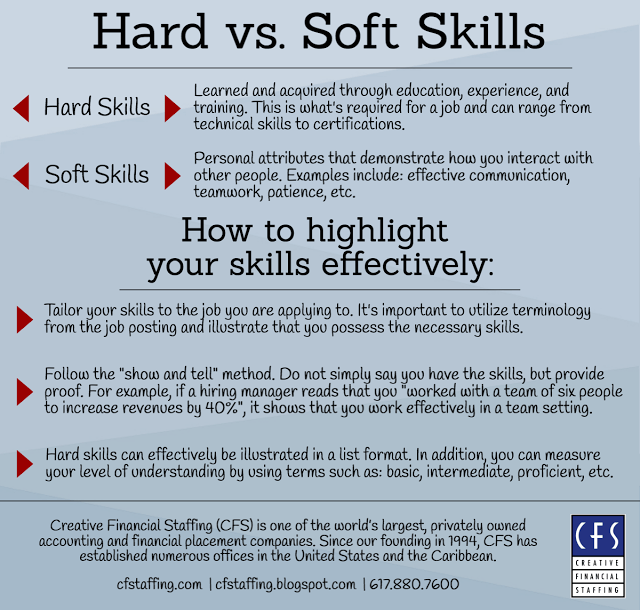
Have questions about your job search or your resume? We want to hear them! Comment below or contact one of our expert recruiters today! Find the closes CFS location to you here.
50 Highest Paying College Majors Via Glassdoor By Allison Berry
October 17, 2016
With approximately 70% of American high school graduates enrolling in colleges and universities each year, a college degree has become an essential stepping stone to landing a great first job.
But when it to comes to your earning potential, not all degrees are created equal.
So which majors really pay the highest?
Through an analysis of hundreds of thousands of resumes and corresponding salary reports, Glassdoor has determined which majors pay the most during the first five years out of college. While STEM majors take most of the top spots, other majors can also pay you generously. Plus, for each major, we’ve identified three of the most popular jobs that new grads really take upon entering the real world.
The 50 Highest Paying College Majors are:
1. Computer Science
- Median Base Salary: $70,000
- Popular Entry-Level Jobs: Software Engineer, Systems Engineer, Web Developer
2. Electrical Engineering
- Median Base Salary: $68,438
- Popular Entry-Level Jobs: Electrical Engineer, Systems Engineer, Software Developer
3. Mechanical Engineering
- Median Base Salary: $68,000
- Popular Entry-Level Jobs: Mechanical Engineer, Design Engineer, Project Engineer
4. Chemical Engineering
- Median Base Salary: $65,000
- Popular Entry-Level Jobs: Chemical Engineer, Process Engineer, Project Engineer
5. Industrial Engineering
- Median Base Salary: $64,381
- Popular Entry-Level Jobs: Industrial Engineer, Quality Engineer, Production Planner
6. Information Technology
- Median Base Salary: $64,008
- Popular Entry-Level Jobs: Programmer Analyst, Technical Support, Systems Engineer
7. Civil Engineering
- Median Base Salary: $61,500
- Popular Entry-Level Jobs: Civil Engineer, Structural Engineer, Field Engineer
8. Statistics
- Median Base Salary: $60,000
- Popular Entry-Level Jobs: Data Analyst, Statistician, Data Scientist
9. Nursing
- Median Base Salary: $58,928
- Popular Entry-Level Jobs: Registered Nurse, Licensed Vocational Nurse, Case Manager
10. Management Information Systems
- Median Base Salary: $58,000
- Popular Entry-Level Jobs: Network Administrator, Help Desk Analyst, Business Analyst
11. Finance
- Median Base Salary: $54,900
- Popular Entry-Level Jobs: Financial Analyst, Investment Banking Analyst, Accountant
12. Mathematics
- Median Base Salary: 54,018
- Popular Entry-Level Jobs: Math Teacher, Software Engineer, Data Analyst
13. Biomedical Engineering
- Median Base Salary: $52,814
- Popular Entry-Level Jobs: Biomedical Engineer, Service Engineer, Clinical Research Associate
14. Accounting
- Median Base Salary: $52,000
- Popular Entry-Level Jobs: Accountant, Auditor, Financial Analyst
15. Economics
- Median Base Salary: $52,000
- Popular Entry-Level Jobs: Financial Analyst, Management Analyst, Accountant
16. Physics
- Median Base Salary: $50,000
- Popular Entry-Level Jobs: Physicist, Research Fellow, Computer Programmer
17. Biotechnology
- Median Base Salary: $50,000
- Popular Entry-Level Jobs: Laboratory Technician, Quality Control Analyst, Research Associate
18. Architecture
- Median Base Salary: $50,000
- Popular Entry-Level Jobs: Architect, CAD Designer, Project Designer
19. Fashion Design
- Median Base Salary: $50,000
- Popular Entry-Level Jobs: Fashion Designer, Textile Designer, Stylist
20. Business
- Median Base Salary: $47,850
- Popular Entry-Level Jobs: Account Manager, Marketing Manager, Market Research Analyst
21. International Relations
- Median Base Salary: $45,880
- Popular Entry-Level Jobs: Marketing Associate, English Teacher, Research Assistant
22. Graphic Design
- Median Base Salary: $45,846
- Popular Entry-Level Jobs: Graphic Designer, Web Designer, Art Manager
23. Marketing
- Median Base Salary: $45,475
- Popular Entry-Level Jobs: Marketing Coordinator, Account Executive, Marketing Analyst
24. English
- Median Base Salary: $45,000
- Popular Entry-Level Jobs: English Teacher, Editor, Copywriter
25. Political Science
- Median Base Salary: $45,000
- Popular Entry-Level Jobs: Law Clerk, Paralegal, Consultant
26. History
- Median Base Salary: $45,000
- Popular Entry-Level Jobs: Research Assistant, History Teacher, Teaching Assistant
27. Human Resources
- Median Base Salary: $45,000
- Popular Entry-Level Jobs: HR Coordinator, Corporate Recruiter, HR Analyst
28. Journalism
- Median Base Salary: $45,000
- Popular Entry-Level Jobs: Reporter, Editor, Public Relations Coordinator
29. Advertising
- Median Base Salary: $45,000
- Popular Entry-Level Jobs: Account Executive, Marketing Analyst, Media Planner
30. Philosophy
- Median Base Salary: $45,000
- Popular Entry-Level Jobs: Teaching Assistant, Writer, Consultant
31. Environmental Science
- Median Base Salary: $45,000
- Popular Entry-Level Jobs: Environmental Scientist, Laboratory Technician, Safety Manager
32. Social Science
- Median Base Salary: $45,000
- Popular Entry-Level Jobs: HR Assistant, Management Consultant, Visual Merchandiser
33. Spanish
- Median Base Salary: $44,256
- Popular Entry-Level Jobs: Spanish Teacher, Spanish Translator, Project Manager
34. Communications
- Median Base Salary: $44,190
- Popular Entry-Level Jobs: Public Relations Coordinator, Journalist, Content Marketing Manager
35. Interior Design
- Median Base Salary: $44,098
- Popular Entry-Level Jobs: Interior Designer, Visual Merchandiser, Drafter
36. Chemistry
- Median Base Salary: $44,000
- Popular Entry-Level Jobs: Pharmacy Technician, Chemist, Laboratory Technician
37. Music
- Median Base Salary: $44,000
- Popular Entry-Level Jobs: Music Teacher, Audio Engineer, Media Sales
38. Film Studies
- Median Base Salary: $44,000
- Popular Entry-Level Jobs: Production Coordinator, Video Editor, Proposal Manager
39. Public Relations
- Median Base Salary: $43,156
- Popular Entry-Level Jobs: Public Relations Coordinator, Account Executive, Event Planner
40. Sports Management
- Median Base Salary: $43,156
- Popular Entry-Level Jobs: Personal Trainer, Sales Associate, Production Assistant
41. Education
- Median Base Salary: $43,000
- Popular Entry-Level Jobs: Special Education Teacher, Elementary School Teacher, Language Arts Teacher
42. Anthropology
- Median Base Salary: $43,000
- Popular Entry-Level Jobs: Project Coordinator, Research Assistant, Administrative Assistant
43. Hospitality Management
- Median Base Salary: $42,734
- Popular Entry-Level Jobs: Food and Beverage Manager, Front Desk Manager, Housekeeping Manager
44. Biochemistry
- Median Base Salary: $42,672
- Popular Entry-Level Jobs: Research Technician, Pharmacy Technician, Chemist
45. Liberal Arts
- Median Base Salary: $42,500
- Popular Entry-Level Jobs: Sales Manager, Receptionist, Teacher
46. Psychology
- Median Base Salary: $42,000
- Popular Entry-Level Jobs: Case Manager, Mental Health Counselor, Sales Associate
47. Sociology
- Median Base Salary: $42,000
- Popular Entry-Level Jobs: HR Assistant, Account Manager, Administrative Assistant
48. Healthcare Administration
- Median Base Salary: $42,000
- Popular Entry-Level Jobs: Medical Assistant, File Clerk, Office Manager
49. Social Work
- Median Base Salary: $41,656
- Popular Entry-Level Jobs: Social Worker, Mental Health Counselor, Camp Counselor
50. Biology
- Median Base Salary: $41,250
- Popular Entry-Level Jobs: Lab Assistant, Paramedic, Tutor
So for those pulling their hair out trying to decide on a college major, what does this mean for you?
“If college students want to land a high-paying job after graduation, they should strongly consider majoring in science, technology, engineering, or math,” says Dr. Andrew Chamberlain, Glassdoor Chief Economist. “STEM majors are in demand by the technology and health industries, which offer higher paying jobs that are better protected from competition or automation.”
______________________________________________________________________
Which city should you move to after college? Consider one of the Best Cities for Jobs
Which company should you work for? Check out Glassdoor’s Best Places to Work
Want to land that dream job? Read up on these 4 pro tips
How much money do you make? Share your salary to join the #ShareYourPay movement.
______________________________________________________________________
Methodology: Nearly 500,000 resumes were analyzed for Glassdoor’s report on the 50 Highest Paying College Majors. For a major to be considered, Glassdoor must hold at least 400 distinct resumes as of 10/03/16, in which a job seeker and/or employee has indicated graduating from college with the corresponding major. To determine the median base salary for each major, career progression data, including job titles, within the first five years of work upon graduating from college was analyzed with corresponding salary data, submitted by employees on Glassdoor. To determine the rankings, majors were then sorted by their corresponding median base salary within the first five years upon graduating from college or university.
7 things to consider when deciding where to intern Article originally published on Huffington Post
If you have multiple offers for an internship position, how do you decide which one to take? First of all, congratulations—this is what’s referred to as a “high class problem.” Second, by considering the following information, you’ll stand a great chance of making the right choice and fast-tracking your career.
- Which company has the most name recognition?
Having an internship on an indie film that never sees the light of day may be terrific real world experience, but it’s not as good a resume builder as summer intern at Paramount, or office intern for the next JJ Abrams film. In the beginning, you want to have the most recognizable companies or projects on your resume. Even if it’s subconscious, a future employer will think, “Well, I’m sure a big studio like Paramount really vets their employees, so this candidate would be a good bet for us, too.” It gives you instant credibility and makes you stand out from a pack. - Is it paid?
Student loans are real. So, depending on your situation, you might need to take something for the money. I’d like to think we live in a world that values experience over a dollar, but we have to be realistic. - What’s the company’s success rate of interns becoming full-time employees?
Some internships are just places to learn. But one day, it could be a place for you to earn. So, ask the question—as one opportunity might have better long term potential than another. - How many days a week/hours in a week will you be working?
Every situation is different and you need to make sure that you can keep your grades up and also give the required time and effort to an internship. Be realistic with yourself about how much you can handle. A CAA internship is a regular 40 hour work week, while an entertainment finance company might have you come in once a week for an afternoon. - Will you have access to the executives?
Most internships are spent doing work that nobody else wants to do. A few years ago, I had an intern working on other side of my desk. Literally. I said, “If this is uncomfortable to be this close, I totally get it, but we don’t have the space for you, and I don’t mind at all.” He was doing data entry, had a great personality, and was easy to be around. He would engage me in conversation and was interested in the stories of where I worked and with whom. He was an excellent intern. When he completed his internship, I told him I’d be happy to be a reference for him anytime. Well, a few months later, he wanted a job at Ben Silverman’s company, Electus. Because of our conversations over the summer, he knew that I knew Ben. Without hesitation I emailed Ben, telling him about this fantastic intern. Ben responded, and my intern was hired by Electus! Take the internship that will give you the best access to some of the executives who could eventually help you. - Are you interested in what the company is known for?
If you love reality TV, working for Evolution Media, producers of The Real Housewives of OC and BHwould be ideal for you. This is where you can really shine. If you’re asked to cover the phones when the receptionist has a doctor’s appointment, you’ll look like a star when all of those hours of TV watching actually help your career. A woman on the phone named Lisa calls for the Head of the Company, you intuitively know to ask, “Is this Ms. Vanderpump or Ms. Rinna?” It shows that you’re really invested in what the company does and that you’d make a great future employee. Let your natural interest be your guide. - Location
Will it be easy for you to get to and from the internship and still make your classes? Will it make sense for you to drive everyday from your apartment downtown LA to Canoga Park to work for 2 hours? The answer to that one is a definite no; it will be more hassle than it’s worth. If it were a full-time job, I’d feel differently. But if you’re deciding between two internships, then accounting for traffic and distance is essential.
Have questions about your job search? We want to hear them! Comment below or contact one of our expert recruiters today! Find the closes CFS location to you here.
Read the original article published on Huffington Post.
Posted by Creative Financial Staffing at 9:29 AM
Price of Oil – October 11th 2016
Crude Oil and Commodity Prices
October, Tuesday 11 2016 – 09:35:22
|
|
||||||||||||||||||||||||||||||||||||||||
|
|||||||||||||||||||||||||||||||||||||||||



 1.54 3.00%
  Houston's F&A Recruiter and Talent Connector