Senior Accountant – SW Houston

Job Responsibilities:

  • Ensure accurate and timely close process through preparation or review of monthly close schedules, journal entries, reconciliations, etc.
  • Prepare, analyze and/or review various internal and external financial statements, reports, depreciation schedules, and variance analysis in accordance with GAAP, with a high level of accuracy while ensuring deadlines are met
  • Assist in the coordination and completion of annual financial audits and preparation of audit schedules
  • Prepare reconciliations as necessary to ensure the accuracy of the company’s books
  • Prepare bank reconciliations on a monthly basis
  • Develop and implement procedures by analyzing current processes and recommending changes; monitor the implementation and maintenance of internal control procedures
  • Ensure financial records are maintained in compliance with accepted policies and procedures, including document storage for reports and working papers
  • Apply project management skills including creating work plans, scheduling work to meet deadlines, obtaining documentation, preparing work papers, researching / resolving issues, liaising with external audit teams and especially communicating status of projects
  • Provide excellent customer service to both internal and external clients

Qualifications:

  • Bachelor’s degree in Accounting
  • CPA desired
  • Strong financial background
  • Strong Excel skills including pivot tables, v-lookups, interest calculations, present value calculations and other advanced formulas
  • Strong understanding of general ledger accounts
  • Diligence and self-discipline to produce high-quality, well-documented work with minimal supervision and errors
  • Solid analytical skills to resolve increasingly difficult accounting challenges
  • Able to coordinate complex projects from start to finish and highly responsive and committed to results
  • Flexibility to work additional hours as necessary

Accounting Manager – Woodlands – dlemaire@cfstaffing.com

Accounting Manager with Public Accounting background needed in The Woodlands! 

  • Supervising a team of Staff and Senior Accountants
  • Supervising month-end close, including preparing and reviewing journal entries, account reconciliations, roll forwards, and financial statements
  • Assist in researching technical topics in accordance with Generally Accepted Accounting Principles (GAAP) and Securities and Exchange Commission (SEC) regulatory requirements
  • Ad hoc reporting for Corporate Accounting, Senior Management, others
  • Prepare Budgets, cash flow projections and financial analysis
  • Administration and maintenance of JD Edwards general ledger and job cost applications
  • Undergraduate Degree with major or focus in Accounting
  • Graduate Degree preferred
  • CPA
  • Minimum of 5 to 10 years of accounting experience required. Big 4 or large regional accounting experience is preferred.
  • Real estate industry and project cost accounting experience.
  • Extensive knowledge of Microsoft Excel, Word, Access and related products.

What makes a job seeker stand out via CFS

What makes a job seeker stand out

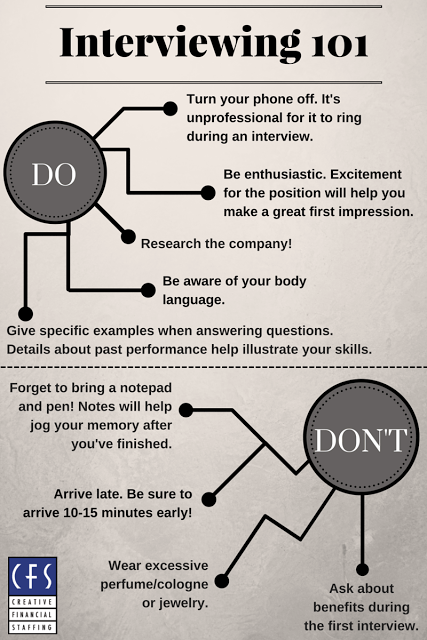
You submitted your resume and landed the interview, but what next? As you research the company and prepare for commonly asked interview questions, you must ask yourself one thing: How can I make myself stand out? Luckily, some of our expert recruiters here at CFS have some tips to help you do just that.

Be Professional

Have you ever heard the phrase, “You only have one chance to make a first impression?” This saying couldn’t be any truer when it comes to interviewing for a job. It is crucial to arrive 5-10 minutes early and to dress professionally. Our recruiters cannot stress that enough! This means a suit or a dress. Jeans are not acceptable. In addition, have multiple copies of your resume and a notepad and pen to take notes with.

Be Personable

In an interview, you need to turn the interview into a conversation. Ryan Glick, Executive Recruiter of CFS Shelton, remembers people who he connects with on a deeper level. It’s not just about proving that you have the skills necessary to do the job, but that you can fit in at the company. Ryan advises to not only speak about the position but to also be personable.

Be Able to Elaborate

It is crucial to be able to explain yourself. You need to answer each question with poise and provide strong examples with strong details. The interviewer has already read your resume, so now is the time to expand upon your qualifications. Now you can really delve into what you are looking for, why you want the job, and what you can bring to the company. This is your chance to put a face to the name and make a lasting impression.

Diane Lemaire, Senior Managing Director of CFS Houston, highly recommends creating a story with your answers. Be careful not to ramble though. The goal is to create a visual in the interviewers mind. Diane adds that the interviewer wants to be able to picture you at the desk doing the job. If you can accomplish this during your interview, you will have a distinct advantage over other candidates.

Stable Background

The duration of employment under your work experience stands out to a recruiter or hiring manager. Yes, working for a strong company is an added bonus, but a proven track record of staying with a company truly stands out.Randy Schwartz, Branch Manager of CFS Nashville, says that staying with a company and making changes when it advances your career is noteworthy. If a candidate has long-term goals, knows the steps to achieve them, and makes the decisions necessary to do so then they will be successful.

On the other hand, if a candidate has held many different positions in a short period of time, then a recruiter or potential employer will question their loyalty. They will question how long you’ll want to stay at their company and hesitate when it comes to hiring you.

Have Questions

This is a great way to stand out! The question segment of the interview typically allows you to prove that you’ve done your research on the company and is essentially your time to shine. While you should ask some questions that illustrate your knowledge, don’t ask these questions because you have to. Ask uncommon questions as well. An interviewer will remember someone who asks unique questions and will appreciate your intellectual curiosity.

Strong Communication Skills

Aside from interviewing well, you must communicate via email/phone in a professional manner as well. Coleen Trombley, Managing Director of CFS Hartford, says that getting back to your recruiter/interviewer helps you stand out. Taking that extra effort to respond quickly and give feedback to your recruiter will set you apart from other candidates who are not as efficient.

Send a Thank You

Now that the interview is over, it’s time for the Thank You card. Mike Ruben, Managing Director of CFS Fort Lauderdale, says that sending a Thank You note is a crucial step that many candidates commonly overlook. An email is perfectly acceptable, but if a candidate sends nothing then they hurt their chances. If the decision comes down to someone who sent a Thank You and someone who didn’t, the recruiter will lean heavily towards the one who did. In addition, this note is your last chance to solidify why you are the best person for the position. Who wouldn’t want that chance?!

Have questions about how you can stand out in your job search? We want to hear it so comment below! You can also reach out to one of our expert recruiters. Find the closest location to you here.

SEC Controller – WEST Houston

Must have public accounting and recent SEC experience. Must be CPA.

RESPONSIBILITIES:

•Manages period, quarter, and year-end close process

•Directs the timely & accurate preparation of all financial statements including balance sheets, income statements and cash flow reports for month end and year end process
• Ensures proper recording of transactions and compliance with applicable laws and regulations
• Analyzes period financial statements and provides commentary for management reporting

• Establishes accounting classifications of all expenditures
• Develops accounting policies and procedures to be used by corporate and field locations
• Administers treasury function of the company, including account maintenance, transfers, and credit cards
• Oversees accounts payable processes
• Manages requirements under debt agreements, including funding, repayment, and interest settlements
• Arranges for and acts as primary contact with organization’s independent auditors on accounting matters
• Prepared audit materials to facilitate internal and external audits
• Researches transactions to ensure compliance with applicable technical accounting guidance
• Maintains internal control environment to ensure compliance with Sarbanes-Oxley requirements
• Assists in preparation of all SEC regulatory filings.

EDUCATIONAL/EXPERIENCE REQUIREMENTS:
• Bachelor’s Degree in Accounting / Finance, with CPA required
• A minimum of three to five years of prior controller experience in a public company, preferred
• Three to five years public accounting experience
• SOX reporting experience


Senior Corporate Accountant – Galleria – dlemaire@cfstaffing.com

Job Summary 

The Senior Accountant – Corporate Accounting will work with the Senior Manager – Corporate Accounting to ensure corporate business transactions are properly recorded in the Company’s financial statements.

Principal Duties and Responsibilities

• Assist management with budget development, forecast updates and perform cost monitoring activities by tightly working with Corporate department heads.
• Perform variance reviews of G&A and operations support costs, researching variance root causes, and determining action plans to improve financial statement or outlook accuracy.
• Application of GAAP, internal accounting procedures and best practices in support of structured financial control environment.
• Perform & review account reconciliations and journal entries to ensure accuracy and validity of accounting transactions and company books and records.
• Lead the process of recording income tax-related journal entries and reconciling tax accounts. Work closely with the Tax Department to resolve issues.
• Lead the process of recording cash flow and balance sheet hedge entries and reconciling of related accounts. Work closely with the Treasury Department to resolve issues and in understanding issued financial instruments.
• Lead the process of recording debt-related journal entries and reconciling of related accounts. Work closely with the Treasury Department to resolve issues and in understanding changes in debt structure.
• Design and ensure effective operation of company internal controls;
• Perform special projects as assigned by management, including process monitoring and close process improvement initiatives; Identify process improvement inefficiencies and suggest potential solutions.
• Respond to audit requests for support documentation.
• Respond to various requests for ad hoc financial information.

Required

• Bachelor’s or Master’s degree from accredited college or university (in Accounting or Finance) required.
• Minimum of 4+ years of professional experience, preferably a mix of public accounting and industry

Preferred

• Certified Public Accountant (CPA) certification
• Masters Business Administration or similar advanced degree
• Strong understanding of PeopleSoft ERP
• Working knowledge of Hyperion Planning and Essbase


5 Signs of an Outdated Resume Written by Alan Carniol

Remember that your resume is your personal brand! You are unique. Do not send a “canned” version of your resume! You want to stand out. I love when I see a LinkedIn address on a resume too!

5 Signs of an Outdated Resume

Written by Alan Carniol

http://www.interviewsuccessformula.com/job-search-advice/5-signs-of-an-outdated-resume.php

Now more than ever, the world is constantly changing. There are things that we do today that may not be the best way next week or next month. Like other things in life, the interview and hiring process is in flux. There are things that weren’t accepted before that are now expected, and if you’re not willing to adapt, you’ll be left behind.

One of the things that have changed over the years is resumes. Some of us have had difficulty keeping up with the changes in the modern resume. These are some of the signs that you may need to seriously consider updating your resume:

You’re still using an objective – Objectives are one of the most outdated parts of a resume. The focus of a company is to understand what you can do for them, not what you want for yourself.

Even better, consider using a headline instead. Why? Because it shows that you’re a confident individual rather than someone who is unsure of him or herself.

Written with pretentious words – Every job seeker wants to stand out, but using words to try to look like someone you’re not won’t help your cause. You have to keep it simple while also adding a little bit of personality to it.

Outline of positions without specific achievements – One reason why resumes have changed is because they don’t offer enough information to help an employer with their decision. It only shows what your previous positions and responsibilities were, while failing to explain what you accomplished.

Too simplistic – The old adage is that simple is better, but today when you want to stand out, keeping it simple might not be enough. Using font styles that are a bit more modern and avoiding decades-old layouts might be a good idea.

Too much old information – What’s important is what you did in the past two to four years, not what you did a decade ago. While those experiences will help you, what you’ve been doing recently is what matters most for an employer.

The difference between a good resume and a great one lies in subtle changes that can go a long way in gaining the attention of an employer. Being aware of these changes can help you get more interviews for the job you want.


Here are some other links:

http://www.job-hunt.org/personal-branding/stronger-resume-branding.shtml


AR Specialist – West Houston

dlemaire@cfstaffing.com

Responsibilities:

  • Invoicing
  • post payments
  •  Daily Sales reports
  • Weekly Sales reports
  • Send customer statements
  • Collections
  • Create customers
  • Month-end sales reports
  • Be the back up for AP person

Required:

  • 2-3 yrs of experience
  • Must be excel proficient (pivot tables, vlook ups)
  • Preferred Oracle experience (not required)

Staff Accountant – Galleria

Our client is looking for a self-starter that is eager to learn and contribute.

Overview: 

  • process journal entries
  • daily sales reports & bank deposits
  • account reconciliations
  • assist with month end

Requirements: 

  • Accounting degree
  • 1 plus years  of experience

dlemaire@cfstaffing.com


Senior Accountant -West Houston

Senior Accountant: 

Prepare journal entries and review transactional data to ensure accurate financial reporting

Reconcile, analyze, and review general ledger accounts in preparation for month-end close to ensure accuracy and validity of accounting transactions.
Bank Reconciliations
Record payroll journals
Maintain Patent and Trademark Schedule
Maintain Sales Productivity reports
Calculate Commissions
Be the back up for AR functions
Assist in Ad-hoc project/reports
Ability to work independently without close supervision

Required:
Bachelor’s Degree in Accounting-required
3+ yrs of experience
Must be excel proficient (pivot tables, vlook ups)
Preferred Oracle experience (not required)


Technical Accounting Manager

Responsibilities

•Prepare and/or review technical accounting memoranda evidencing and supporting the company’s application of US GAAP to specific transactions, events, or contracts
•Evaluate anticipated transactions and structures and provide recommendations to meet business and financial needs while complying with US GAAP and regulations
•Formulate and update existing company accounting policies and procedures in accordance with U.S. GAAP
•Coordinate and effectively communicate accounting matters with various departments throughout the company, including operational reporting and consolidation departments
•Identify evolving business practices and their implications on company accounting policies and procedures
•Organize and lead accounting training sessions to assist accounting and finance personnel apply company financial standards
•Communicate with accounting and finance personnel to provide guidance to ad-hoc accounting and finance inquiries
•Support the planning and review of SEC filings and other financial statements (10-Ks, 10-Qs, 8-Ks, 11-Ks, proxy statements, pension plan financial statements), including timely completion of technical accounting documentation surrounding the company’s financial filings

Requirements

•Bachelor’s and Master’s degree in accounting required
•Certified Public Accountant (CPA) required
•5+ years of financial accounting experience with large public accounting firm and/or corporate/industrial experience
•Technical accounting (U.S. GAAP) proficiency
•Strong ability to work independently and lead significant projects related to implementation of new accounting standards
•Demonstrates leadership qualities, strong work ethic, attention to detail, and excellent organization and project planning skills
•Excellent written and verbal communication skills
•SEC reporting experience preferred
•Flexible to work overtime as required

7 Common Characteristics of Unproductive Employees BY ADAM HEITZMAN

7 Common Characteristics of Unproductive Employees BY ADAM HEITZMAN

Terminating employees can be a difficult thing for any manager or organization. Here are seven characteristics to keep an eye out for to determine if it’s time to let an individual go.

When it comes to a business setting, you can think of “unproductive” in three different ways. First, an employee can be so outgoing and bubbly in the office that you actually miss the fact that he/she has never really actually been productive. Second, you can see that an employee’s work is starting to fade or decline and realize that the employee has become unproductive. Or lastly, and employee may just plain be unproductive and everyone knows it.

However, in all three situations, the characteristics of someone being unproductive are the same. How they got there or why they’re there might be a different story, but as an employer it all starts with being able to recognize some of these characteristics. If you can recognize that an employee is unproductive that’s the first step in making changes.

Consider some of these traits and actions to look for below:

Complaining

It doesn’t matter why someone is complaining or whom he/she is complaining to (or about), complaints often show that someone is not willing to put in the work to make a change. It’s a time waster, and it’s almost always easier to complain than to be productive. As John Brandon mentioned in a past article, “The really productive people don’t dwell on the problem. They just do the work.”

Making Excuses

Similar to complaining, making excuses is not the way to be productive. It’s one thing if things don’t get done because other things take priority, but if something doesn’t get done because of an unfair excuse, then that’s a problem with the employee. Start paying attention and see if there seems to be an excuse for everything. One or two every once in a while is OK, but excuses can get out of hand quickly.

Putting Things Off

This characteristic can go right along with excuses. Most of the time an employee will put something off because of an excuse, but sometimes you’ll notice that he/she will act like it can wait and brush a task off as “not a big deal.” Again, while this might be okay in small doses, if it becomes a habit you have a problem.

Running Everything By the Boss

This may happen for two reasons: Either the employee is hoping the boss will just do the work or delegate it to someone else (usually because of excuses the employee lays out) or the employee doesn’t feel like he/she can be independent and get things done. In either situation, an employee won’t be productive. Part of productivity is being able to take the problems at hand and get creative and work hard to solve them, and actually wanting to solve them. Running to the boss doesn’t help anyone get to that point and therefore hurts productivity.

Only Caring about Getting Credit

This is a classic sign of someone who does not really care about the job; therefore only worrying about being productive if it’s going to get him/her credit in the long run. In order to really be productive you have to be creative and innovative in your role–simply doing what your told and then stopping your work isn’t always using your time efficiently. Even more so than being unproductive, this is a characteristic that really shows when an employee is not motivated, which brings us to our next point.

There is No Motivation or Drive

You can usually tell if someone does not have motivation or drive for a business if they’re doing all of the things mentioned above–making excuses, putting things off, complaining, always bothering the boss, etc. All of these feelings combined with a lethargic attitude contribute to not being productive. Why would an employee be productive if they don’t care about the company and what that productivity could produce? After all, being productive takes work.

In some cases, there is a lack of motivation and productivity simply because that employee was the wrong fit to begin with.

Personal Betterment and Brand is Slipping

This is usually what happens when people get complacent at their job. Maybe they’re doing what they’re told and not making excuses or complaining, and maybe even sometimes they solve problems on their own and get things done, but if their personal brand and betterment is slipping then the work turns to routine and productivity. Part of being productive is learning new skills and taking pride in an online brand (even if it’s just to help the company). This shows independence and it shows motivation. Without this, productivity lacks.

The Takeaway

As you can see, a lot of the characteristics mentioned above compliment one another and string together. It almost works like a domino effect, so you’ll likely see an unproductive employee exhibiting more than three or four characteristics on the list. The best thing you can do as an employer is be able to look for and recognize these traits and then take steps to re-motivate the employee.

The opinions expressed here by Inc.com columnists are their own, not those of Inc.com.
PUBLISHED ON: MAR 1, 2016

8 Reasons You Should Consider Hiring a Job Hopper By Mark Wilkinson

8 Reasons You Should Consider

Hiring a Job Hopper

By Mark Wilkinson

Many recruiters will refuse to even consider hiring a job hopper (usually) because…

  • “They’re clearly disloyal.”
  • “They absolutely must be a trouble-maker.”
  • “They’re obviously lazy and fickle.”

Balderdash! In my experience, job hoppers are some of the most appealing candidates out there! And here’s why…


1. They are risk-takers.

Deciding to embark on a new career, within a new company, is a risk.

Will I fit in? Will I be able to do the job? Will the management team like me?

The “easy” option would be to stick with what you know (unless what you know is truly terrible).

So by definition, your job hoppers are actually a lot more likely to be risk-takers and apparently, smarter than your average Joe too!

2. They must be adaptable.

frog camoflaged against pondAcross different companies, your job hopper will encounter a variety of different people and will be asked to complete a variety of different tasks.

It’s therefore pretty essential that they can adapt – to different people, company cultures and roles.

So, if you’re looking for someone who gets stuck in to everything and who gets on with most people, the job hopper could be right choice for your business.

 (Of course, if they only ever stick around for a couple of months and haven’t got any employment references, then the complete opposite could be true, so be wary!)

3. They’ll have a variety of skills.

Even companies in the same industry will use different strategies, programs and techniques to get things done, which means your job hopper will have picked up a variety of different skills.

(From simple things like CRM systems to entirely different ways of working).

Your job hopper will be a keen learner and could bring some fabulous skills and techniques to your business.

4. They know people.

Herd of kangaroos at twilight (Coombabah Lake, QLD, Australia)

You never know when a job hopper’s own network will come in useful!

From their previous clients and employers to colleagues and suppliers, you’d be surprised how many useful connections one person can build.

(And because they’re adaptable, they’re likely to have good relationships with these people.)

5. They’ll bring new ideas.

Your job hopper will be able to bring a wider variety of new ideas to the table.

Perhaps they’ve used a better CRM system, have used various research tools and techniques, have trialled a variety of agencies or products etc.

The knowledge they have gained across different companies could improve your own processes!

6. They’re ambitious.

grasshopper sitting on some moneyThe most common type of job hopper is one who keeps leaving for bigger and better things.

When they feel they’ve gone as far as they can at their current workplace and that there’s nothing left on offer, they move on (this is a common behaviour amongstmillennials).

Of course, ambitious employees are much more likely to be enthusiastic about making a difference to your business (and making a name for themselves in the process).

Job hoppers know what they want and they aren’t afraid to go get it!

7. They’re not lazy.

I’ve heard many recruiters call job hoppers lazy… but I’ve never actually found that myself.

Think about it; looking for, securing and starting a new job is definitely not easy; in fact, job hunting is pretty much a full-time job these days.

As such, I tend to find that job hoppers are more proactive, enthusiastic and ambitious – how else would they have to energy to re-write CVs, attend interviews and change careers?

Sticking with what you know is certainly less effort.

8. It’s all relative, anyway!

goldfish jumping out of the water from a crowded bowl

Does it even really make a difference if a candidate is a job hopper? Is it fair to pigeon-hole them?

At Coburg Banks, we think everyone should be given the benefit of the doubt.

If you’re unsure then ask the question; find out whythey’ve left other businesses – they may just have been unlucky and not found their dream company yet – you’ll never know if you don’t ask.

Don’t risk losing a great employee, for the sake of an old stereotype.

Of course, there is always a downside…

The 8 reasons I’ve outlined above are all based on trends I have personally picked up on (and a bit of common sense) but of course, you will occasionally just come across a bad egg!

Recruiter Pro Tip

Here are some warning signs that your candidate could be one of the “bad” job-hoppers:

  • They don’t have any references from previous companies (are they a trouble-maker)?
  • They regularly flit between careers and industries (do they actually know what they want)?
  • They don’t have a reason for leaving their current job (do they just get bored)?

…use your gut instincts and probing questions to suss these things out!

If you’d like to read more about attracting a recruiting good egg, click here to subscribe to this blog; we’ll send over a quick weekly update with the latest industry news and advice!

– Mark Wilkinson