Internal Audit Manager – Houston, Texas – dlemaire@cfstaffing.com

The Internal Audit Manager is responsible for monitoring and updating the organizations risk assessment, preparing and monitoring an annual audit plan, and executing the audit plan.  The Audit Manager will manage a team of internal and outsourced auditors.

Areas of Responsibility and Essential Duties include:

  • Maintains and annually updates the organizations Risk Assessment.
  • At least annually updates an Internal Audit Plan.
  • Creates, monitors, and tests all internal controls.
  • Guides internal audit decisions by establishing, monitoring, and enforcing policies and procedures.
  • Monitors and confirms financial condition by conducting audits; providing information to external auditors.
  • Achieves budget objectives by scheduling expenditures; analyzing variances; initiating corrective actions.
  • Prepares internal audit reports by collecting, analyzing, and summarizing internal audit information.
  • Completes internal audit requirements by scheduling and assigning employees and/or outsourced consultants; following up on work results.
  • Maintains internal staff and outsourced consulting staff by recruiting, selecting, orienting, and training employees.
  • Maintains internal staff and outsourced consulting staff job results by coaching, counseling, and disciplining employees; planning, monitoring, and appraising job results.
  • Maintains professional and technical knowledge by attending educational workshops; reviewing professional publications; establishing personal networks; participating in professional societies.
  • Protects the organization by keeping financial information and plans confidential.
  • Contributes to team effort by accomplishing related results as needed.
  • Adheres to and promotes the values, policies and procedures of the organization.
  • Performs other duties as assigned.


Minimum Qualifications:

  • Undergraduate degree in accounting, finance or business.  Graduate degree preferred.
  • Current CPA license.
  • 8-10 years of relevant experience with increasing responsibility.
  • Managing Processes, Financial Software, Developing Standards, Audit, Accounting, Corporate Finance, Tracking Budget Expenses, Financial Skills, Analyzing Information, Developing Budgets, Performance Management.
  • Proven ability to effectively manage people and supervise work assignments.
  • Must be able to set goals and complete duties and assignments under the pressure of deadlines.
  • Resourceful, detail oriented, strong time-management skills and the ability to effectively multi-task and prioritize.
  • Highly developed written and oral communication, customer service, and problem solving skills.
  • Have an excellent working knowledge of grammar usage, letter writing, and proofreading.

Tax Analyst – Growing Power Services Company – Houston – dlemaire@cfstaffing.com

Are you a Tax professional looking to join a dynamic corporate tax team? Our client, a reputable and rapidly growing organization, is looking to add a strong Tax Analyst to join their team. Do you enjoy problem solving and being an integral part of a growing team? If yes, then this is the position for you!

Why take a Tax Analyst role with this company?
• Exposure to a growing, multi-billion dollar global Fortune 500 company
• Key part of the corporate tax team
• Opportunity to work with a high-performance team
• Ability to grow within the tax/accounting department and/or move to other area of the organization (financial reporting, business analysis, etc)

What the Tax Analyst will do:
• Assist in the state tax provision process
• Prepare state tax payable/receivable reconciliations
• Prepare state tax returns, estimated tax payment and extensions
• Track state tax attributes including state NOLs and valuation allowance

 What the company needs in a Tax Analyst:

• Bachelor’s degree in Accounting or Finance
• Minimum of 1-2 years of public accounting (Big 4 preferred) or corporate tax experience
• CPA Eligible or CPA Certified required

Perks of the Tax Analyst role:

• Competitive base salary up to $80K
• Strong benefits package
• 401-K with match

Senior IT Auditor – West Houston – dlemaire@cfstaffing.com

Job description

  • Participate in audit risk assessment, planning and audit scope development, as well as project execution as a critical team member on large, complex projects
  • Provide SOX and compliance expertise and consulting to the organization, ensuring compliance with all SOX information technology internal controls, application controls, and key reports requirements
  • Prepare and present reports and metrics to management, ensuring controls are accurately maintained and action plans are implemented within designated timelines for remediation
  • Ensure systems, databases, applications, and IT processes comply with all SOX IT General Controls (ITGC)
  • Support new system implementation and ensure compliance with existing policies
  • Update process narratives annually through collaboration with business partners to ensure proper documentation of all significant processes
  • Participate in special projects and initiatives
  • Develop, implement, and maintain audit plans, systems and controls
  • Present audit findings to management
  • Drive successful completion of audit projects by closely coordinating with management, internal and external auditors, external consultants and business process owners
  • Assist in the execution of audit department planning including risk assessment
  • Provide performance feedback to staff auditors and create developmental plans for identified weaknesses
  • Review audit work papers and draft reports prepared by audit staff
  • Develop a thorough understanding of  policies, procedures and safety rules


Qualifications:

  • Bachelor’s degree in Computer Science, Management Information Systems, Accounting, Business Administration or similar field of study required
  • Certified Information Systems Auditor (CISA), Certified Information Systems Security Professional (CISSP), or other IT audit-related certification preferred
  • 3+ years of experience with IT Sarbanes-Oxley (SOX) controls in an audit or IT controls implementation and maintenance capacity
  • Experience working within an Internal Audit or Information Technology organization, supporting enterprise level IT functions and processes
  • Experience executing audits within a complex organization that includes mainframe, distributed, and network platforms
  • Knowledge of ERP systems, data warehouses and knowledge management systems
  • General understanding of business analysis and project management
  • Ability to perform risk assessments, develop audit plans, perform financial and operational audits, report results
  • Knowledge of Sarbanes-Oxley, COSO and COBIT standards, GAAP, current audit practices, new legislation and regulatory requirements and internal auditing standards
  • Demonstrate ability to plan and execute IT audits focused on general computer controls
  • Familiar with IT applications, hardware and software systems, and software development life cycle (SDLC)
  • Strong interpersonal, written and verbal communication skills to interface effectively with individuals at various levels
  • Ability to remain organized, pay attention to detail, and meet critical deadlines
  • Ability to work well under pressure while consistently meeting time sensitive deadlines
  • Analytical with strong problem-solving abilities and creative resolution skills
  • Ability to collect and analyze complex data, evaluate information, and draw logical conclusions
  • Strong Microsoft Office experience, including Excel and Word

Time saving tricks for your job search via www.cfstaffing.com

Time saving tricks for your job search

People tend to exhibit impatient tendencies; we like things to happen quickly. Unfortunately, the job search process is very rarely associated with being a quick or an easy one. Don’t fret though; here are 5 time saving tricks that can help speed up the process.

Get Organized

Organization is essential if you hope to be efficient throughout this process. Tammy Power, Staffing Manger of CFSBakersfield, advises keeping all of your resumes, cover letters, and all other application materials in one place. Create a folder on your desktop dedicated to your job search efforts. Label your resumes by company, date, and anything else that will help you identify them at a later point. In addition, creating an excel file to keep track of all active applications ensures that you don’t miss any deadlines and reminds you when to follow up. It also serves as a great place to store all of the contact information from any hiring managers you have spoken with.

Utilize Job Alerts

It’s time to start using job search boards more efficiently. Shannon Wagner, Director of Staffing at CFS Oakbrook, suggests utilizing websites such as Indeed, CareerBuilder, etc. to enhance your search by signing up for job alerts, saving you the hassle of scrolling through all the job postings on each site. She also recommends creating a separate email that you can use solely for job search purposes. This guarantees that your current inbox won’t be flooded by the daily email alerts. After all, staying organized is key.

Narrow Your Search

In order to best utilize your time, “focus your efforts on applying to jobs that are right for you based on skills, rather than ones that you are interested in but not qualified for,” says Power. Doing so will not only cut down on the time you spend sending out resumes, but it will maximize the number of responses you receive. When it comes to job hunting, the saying “quality over quantity” remains true.

Position Yourself on Social Media

In today’s society, social media is inescapable. In fact, many recruiters and hiring managers will screen your social media accounts before they even meet you. LinkedIn has become an essential part of building this social media presence; if you do not have a professional or highly visible profile, then your application may be rejected. Having a strong online presence will not only help push your current applications to the top of the pile, but it will help potential recruiters find you in the future. If you promote your skills throughout your profile and focus on using key terms from your industry, you will have a greater chance of being discovered.

Network, Network, Network

As you apply for various positions, don’t forget that sometimes the best way to learn about new career opportunities is through your network. Go to networking functions or grab lunch with a former colleague. As you put yourself out there, you will meet new people and continuously expand your network. After all, a strong network is always a great thing to have, but it is especially helpful when searching for a new job opportunity.

What time saving tricks do you use? We want to hear it so please comment below!

Are you on the job hunt for a new career? Our recruiters are here to help! Check out our latest job postings here, or find a CFS office located closest to you here.

Staff/Property Accountant – Spring – dvelasquez@cfstaffing.com — Executive Recruiter HTX

If you or someone you know would be interested in discussing this position further, please contact me directly: dvelasquez@cfstaffing.com Key Responsibilities: Reconcile all balance sheet accounts and applicable income statement accounts to ensure accuracy. Prepare monthly bank statement reconciliations and promptly record any reconciling items. Submit wire requests to the Treasury Manager for monthly mortgage […]

via Staff/Property Accountant – Spring – dvelasquez@cfstaffing.com — Executive Recruiter HTX

Hyperion/HFM Analyst – Junior Administrator – Houston, Texas

Responsibilities:

  • Assist with the administration and maintenance of the HFM, FDM and Financial Reports, some of the activities outlined below:
    • Maintaining entity hierarchy structures
    • Maintaining financial statement accounts and dimensions
    • Maintaining calculations
    • Loading exchange rates
    • Loading monthly statistical data
    • Managing and modifying metadata.
    • Security Administration and maintenance
    • Routine upgrades
    • User maintenance/security
    • Report maintenance, creation and quality control
    • General trouble-shooting and user support
  • Assist with the administration and maintenance of the FDM application, including:
    • Maintaining and modifying the account mapping between the HFM database and the two general ledger systems
    • Routine upgrades
    • General trouble-shooting
    • Creating and modifying reports


Qualifications:

  • A bachelor’s degree in business administration, information technology, accounting or finance
  • Three to five years experience working with Hyperion products
  • Accounting and finance acumen – understanding of financial statements, accounting concepts, and analytics
  • Detail-oriented with an emphasis on quality control and reconciliations
  • Self-motivated and independent worker
  • Team-oriented with a positive attitude towards being “on call” and working nights or weekends, as necessary
  • Ability to multi-task and prioritize responsibilities
  • Excellent interpersonal, communication and problem-solving skills

7 ways to break the job-hopping streak Written by: Tatiyana Cure, Executive Recruiter, CFS New York

7 ways to break the job-hopping streak

Written by: Tatiyana Cure, Executive Recruiter, CFS New York

Most recent graduates find themselves with a mountain of student loans and feel obligated to accept the first offer that provides them a decent paycheck. With not much prior experience, they tend to change jobs quickly and often while trying to discover what they are good at, enjoy doing, and need to earn to afford living costs while also paying off student loans.

We have grown to accept the 1-3 years of job-hopping after graduation. However, the job-hopping streak also happens to those who feel pressured to make more money, want to change career paths, are looking to relocate, or simply do not get any satisfaction out of what they are doing. Before you take a new job, consider these steps to break your job-hopping streak:

Determine exactly what you would change about your current situation

Before you seek employment outside of your current organization, speak to your boss. If you’re looking for a higher salary and good at your job, you will get a counteroffer when you put in your resignation, which is tempting to take. However, your loyalty will be questioned and nobody wins in that situation. So, have that conversation before you start applying to other jobs. If you want a promotion but feel that there is no room for growth, voice that you would like to be challenged in your role. You may be surprised to find out that the firm already has a promotion lined up for you or even created a new role.

Identify your ideal situation

This can include: salary range, job title, industry, organization size, culture, benefits, long term incentives, working hours, and anything else you think is important to your long-term success. If you’re currently employed, why would you accept a new job that does not address all the items on your wish list? If you are currently unemployed, you are better off taking on temp gigs or freelance until you find the perfect situation.

Invest back with the company who invests into you

Before you look outside of your organization, ask yourself if the firm has invested in you. Have they provided training, mentorship, and all the tools needed for you to succeed? Most companies have rotation programs, succession plans, and continued development but are only willing to do that if they think their investment will pay off. If your background screams “job-hopper,” it’s unlikely that you will find an outside company to invest into you.

Deepen your experience

If you have held 5 jobs in the last 5 years, realize that you do not have 5 years of experience. Instead, you have 1 year of experience 5 different times. It takes a full year to understand the ins and outs of an organization, and it takes another year to be able to make contributions to the organization. Before you jump ship, ask yourself: “What are my major accomplishments with this organization?” If you’re having a hard time coming up with at least 3 quantified accomplishments (for example: you cut down on cost, increased revenue, or streamlined processes), you haven’t given that job enough time.

Ask the right questions

What do you wish you would have known about your current company before you accepted the job? Was is it the hours? Culture? Personalities? Make a list of the things you wish you would have known, and ask these in your next interview. This will prevent you accepting a role with an organization where you don’t see a long-term career path.

Meet your potential colleagues and peers

Most companies will arrange peer and colleague interviews, but if they don’t, ask to be introduced before accepting the job. Don’t always believe the reviews you read online as most of those come from disgruntled former employees. Speak to those who are currently employed with the organization and ask them about the challenges that they face, how long they have been there, what attracted them to come on board, and what keeps them there. If the company that you are interviewing with prevents these conversations, it should raise a red flag. If you notice that most employees have worked less than a year with the organization, realize that this position will probably not help break your job-hopping streak and consider avoiding it.

Avoid making the same mistakes

If you continue to job hop, you will regress in your career. Some people think that by working in a variety of industries and in diversified roles, they gain additional experience that they otherwise wouldn’t. They try to spin their short-term gigs into a positive, but hiring managers see right through it. Before you accept a new role, make sure you are not repeating the same mistakes that you have made in accepting your previous role(s). Don’t make any rash moves and think things through.

How were you able to break the job-hopping streak? We want to hear it so please comment below!

Are you on the job hunt for a new career? Our recruiters are here to help! Check out our latest job postings here, or find a CFS office located closest to you here.

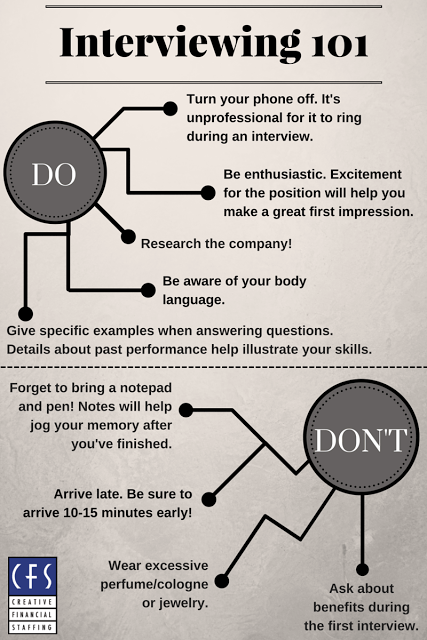
7 Surprisingly Common Interview Mistakes That Cost Smart People the Job BY MINDA ZETLIN


7 Surprisingly Common Interview Mistakes That Cost Smart People the Job

Any of these goofs will send your application to the reject pile.

BY MINDA ZETLIN Co-author, ‘The Geek Gap’

You’re ultra-qualified for the job and super-prepared for the interview. You’ve done your homework, researching both the company and the hiring manager you’re about to meet. You’re prepared with intelligent questions and great examples of past accomplishments that prove you’d be a great fit for this position.

You may think all systems are go, but there’s still a lot that can go wrong, according to career development expert Vicky Oliver, author of 301 Smart Answers to Tough Interview Questions. In fact, she says, research shows that most interviews go south because of social blunders not poor qualifications.

When you interview, the person you’re talking with will extrapolate from your conversation to try and guess what it would be like to have you around every day. Keep that in mind and be careful to avoid these all-too-easy errors:

1. Arriving late, even with a good reason.

Yes, there may have been an accident that caused a traffic tie-up, but it might not matter. “Walking in late, even when you have a legitimate excuse, will test your interviewer’s patience,” Oliver warns. As a practical matter, this means you should plan to be at least a half hour early, and then wait in a nearby cafe, park, or even your car until you can show up five minutes before the appointed time.

“Even worse is showing up late and unprepared,” she adds. Your only hope is to wow the interviewer with your relevant observations and insightful questions. If you can’t do that, you likely won’t get the job.

2. Failing to make eye contact or having a weak handshake.

“Much can be determined about a job candidate’s character from the initial handshake,” Oliver says. “When you have a weak grip, a clammy palm or won’t make eye contact, you imply a lack of confidence and timidity that would make a bad fit in most work environments.”

While failure to make eye contact is not necessarily a sign of meekness or dishonesty, most people instinctively perceive it that way. So practice looking the other person in the eye while shaking his or her hand firmly until it becomes second nature. It will serve you well in all sorts of social situations.

3. Distinctive clothing.

You may love that novelty tie or those big, unusual earrings, but leave them at home when heading to a job interview. Yes, they’ll be memorable — but you want the hiring manager to remember you for your intelligence and personality, not your attire.

“Your professionalism comes across immediately through your choice of interview attire,” Oliver adds. Even in a casual workplace, showing up to a job interview in casual clothes may lead the hiring manager to believe you’ll be casual about your job. Likewise, if your clothes look like they’d be in place at a party, the interviewer may assume you don’t know how to dress for business.

4. Slouching.

Most of us are guilty of this at least some of the time, but don’t let it happen during a job interview. “Body posture conveys a great deal about an applicant’s personality,” Oliver says. “Slumping signifies lack of confidence, leg swinging equates with nervousness, and arms folded against the chest demonstrate belligerence or arrogance. Pay close attention to the cues communicated through your body posture. Hiring managers will read them accordingly.”

5. Talking too much.

If you’re anything like me, you tend to rattle on when you’re nervous but that will work against you in a job interview. “Interviewees who pummel the interviewer with questions, prattle on in their answers, or feel compelled to fill any silence with chit-chat will have hiring managers recoiling from their unchecked verbosity,” Oliver warns. Right or wrong, the hiring manager is liable to assume you’ll be a nonstop chatterbox if you get the job.

6. Bad grammar or excessively informal speech.

Poor grammar signals poor communication skills to most hiring managers, Oliver explains. “Candidates who use colloquial phrases or are very informal with language can’t cut it in the professional world where written and verbal skills are paramount.”

Even worse is profane, derogatory or otherwise inappropriate language, which, she notes, “shows a lack of sophistication or self-censorship.” Make any of these errors and you can expect the interview to end quickly.

7. Unprofessional communication channels.

Your personal email and phone are your own business. Still, Oliver says, if they see “hotmama” or “partydude” as part of your email address, they may think twice before extending a job offer. The same holds true, she says, if your voicemail message features loud music. “No question they’ll move on to their runner-up candidate and you’ll be back to the resume-submitting stage again.”


Tax Director or Tax Manager, Houston, Texas — DIANE DELGADO LEMAIRE Houston’s Accounting & Finance Recruiter

Annual bonus target between 20-25% (has paid out at 100% for the past 2 years) 100% Full Benefits Paid for the employee & dependents – medical, dental, vision, short term & long term disability 401K plan with 5% matching Paid parking downtown Free gym membership to The Met Club Downtown RESPONSIBILITIES: Design and execute a […]

via Tax Director or Tax Manager, Houston, Texas — DIANE DELGADO LEMAIRE Houston’s Accounting & Finance Recruiter

JIB Accountant Lead – Houston


Responsibilities:

*The entire JIB process

*Understand working interest ownerships

*Understand land documents/JOA’s

*Understand COPAS rules

*Effective communicator who will do more than just the bare minimum

Benefits: 

*100% Full Benefits Paid for the employee & dependents – medical, dental, vision, short term & long term disability

*401K plan with 5% matching

*Paid parking downtown


5 Reasons Your Resume Doesn’t Stand Out From the Crowd BY LILY ZHANG

Resume_writing-1


The time has come to look for a job. You’ve been editing your resume like a maniac, taking in all the advice on what to take out and what verbs to use. And after much tinkering and typo eliminating, you’re finally done — and it looks just like everyone else’s. How are you supposed to stand out now?

Fret not. Here are five ways your resume makes a recruiter’s eyes glaze over and, more importantly, smart ways to fix that.

1. You have a generic “experience” section

If your main resume section is “Work Experience” or the slightly better but equally forgettable “Professional Experience,” you’re missing out on a big opportunity to personalize your resume.

In place of “Work Experience,” consider customizing this section to “Event Planning Experience” or “Editorial Experience” — whatever is most appropriate for your skill set and the position you’re looking for. Having a keyword right in your section heading has a great branding effect on your overall resume.

This is especially useful if you have a diverse range of experiences, but really want to show off your experience in one particular area. You can have all of your relevant experience in one section at the top of your resume where the recruiter will first look and add an “Additional Experience” section for everything else.

2. You focus on responsibilities instead of accomplishments

I’m not even going to go into how facepalm-inducing it is to start a bullet with “Responsibilities include,” so let’s just go ahead and assume you start your bullets with great action verbs. Even so, you might still be falling into the trap of describing what you do day to day instead of the projects you’ve completed or the results you’ve contributed to. Here’s an example of how to distinguish between the two:

Bullets on responsibilities

  • Coordinated artist press releases
  • Managed customer mailing list
  • Handled photo and press releases to media outlets
  • Assisted in radio copywriting
  • Performed various other duties as assigned

Bullets on accomplishments

  • Coordinated 8 artist press releases that contributed to an increase in annual sales by 14%
  • Compiled and maintained a mailing list of 12,000 customers, the art center’s largest ever
  • Organized photo and press releases to CNS Television and Yorkville Daily News
  • Collaborated on a team of 3 editors on the copywriting of promotional radio commercials for 16 events

See the difference? The first one shows what you did—while the second details exactly what kind of impact you’re sure to make in the future.

3. You use tons of clichéd buzzwords

Are you a “go-getter” who “thinks outside the box” and is all about creating “synergy” in organizations? That’s great, but recruiters hate seeing these overused buzzwords on your resume.

Instead, think of examples of how you’ve demonstrated these traits in your work. (Need help? Here are a few great cliché-free ways to show off your soft skills. Adding results and accomplishments to your resume is a much more interesting way to show off who you are — and ultimately, makes you much more memorable.

4. You sound like you have no life outside of work

If you are a marketing professional with five years of experience, how are you setting yourself apart from all the other marketing professionals with five years of experience? How do you show your passion for your field or that you have other attributes to bring to your position?

One way to do this is to include a section on your resume for “Community Involvement” or “Leadership.” Alternatively, you could expand your “Skills” section to “Skills & Interests.” Whatever you intend to include, whether it’s the event planning you do for your professional organization or the volunteer math tutoring you do on weekends, make sure to show that you do more than show up at work and do as you’re told.

While you don’t want to take this to an extreme — anything you include should be relevant to the job you’re applying for — it’s a great way to show off who you are as a person.

5. You didn’t include a cover letter

Do you hate writing cover letters? Well, so does everyone else. Which is why few people put in the effort to write a really outstanding one, if they write one at all. Some job applicants think, “Well my experience should speak for itself” or “Everything I have to say about my qualifications is on my resume.”

In some pretty specific cases, that could be true. Even still, in the rigid structure of a resume, your personality just has a much harder time shining through. The cover letter is your chance to really introduce yourself as person and not just as a set of skills.

The next time you have to write a cover letter, try Alexandra Franzen’s approach: imagining that you’re writing to someone who already believes you’re qualified. Take that confidence and go from there.

It’s so important to be open to advice and feedback as you’re creating or updating your resume, but be careful not to take out what makes you special. It could be that extra sparkle that gets your foot in the door!

This article originally published at The Muse here


Job Seekers, Learn These 5 Time-Saving Job Search Tricks By Arnie Fertig, MPA,

http://money.usnews.com/money/blogs/outside-voices-careers/articles/2016-03-22/job-seekers-learn-these-5-time-saving-job-search-tricks?src=usn_tw

Job Seekers, Learn These 5 Time-Saving Job Search Tricks

Posting your contact information on your LinkedIn profile makes it easier for recruiters to get in touch.

140929_laptop

One advantage of LinkedIn’s Groups is that you can communicate directly with anyone in a group of which you are a member, even if you aren’t linked to them.

You’ve probably heard countless times that you should consider looking for a job to be a job in and of itself. In truth, to do it well, it takes a good deal of time and patience. With that said, wouldn’t you like to take some of the drudgery out of the process and use your time more efficiently to connect with the people who can help you and be more organized in your overall approach?

Here are five tips to help you along the way.

1. Name your resume. The document central to any job search remains a resume. But do you have any idea how many people circulate this central piece of their personal brand saved simply as “resume.doc?” It is a pain for people to have to rename your document to save and later retrieve it.

Instead, make a new folder on your hard drive called “Resumes.” Save your resume into it using this formula: “{firstname lastname} resume for.doc.” Each time you are about to send it out, click “save as” and add the name of the person or company you are sending it to. Keep all the versions of your resume in this one folder, without deleting any of them.

2. Save search result links. Whenever you conduct a search – on Google, within a job board or a company site – the results page is a unique URL.

Create a spreadsheet in Excel, Google Sheets or Apple’s Numbers. Create one column for your search terms, another for the URL of the results page and a third for any other notes you want to make about the search. As time goes on, you may think of more things to track, but this is a good start.

Copy the links of all your search results into the appropriate spreadsheet column, then go back on a regular basis and copy that link back into your search engine, and you’ll find the latest updated results to your searches. You’ve saved time and organized your searching.

3. Use LinkedIn’s Groups to communicate directly with people in your target companies. One often overlooked advantage of LinkedIn’s Groups is that you can communicate directly with anyone in a group of which you are a member, even if you aren’t linked to them.

Do a “People Search” on LinkedIn to see with whom you want to speak. If you don’t know them or aren’t connected, you may be limited in your ability to reach out directly. However, as you review their profile, scroll to see in which LinkedIn Groups they are enrolled. Join one or more of those groups to be connected to your target person, and likely many more people like him or her. Once you are a member, you can then message them through LinkedIn, even if you don’t have InMails available.

As a side benefit of this hack, you’ll likely discover a number of groups to join and people with whom you should be connecting.

4. Make yourself easy to locate on LinkedIn. How much better is it to have people reach out to you directly with employment opportunities than for you to continually be pro-actively reaching out to introduce yourself? Of course, that’s why you need a well-optimized LinkedIn profile. But if you happen to turn up as an answer to someone else’s search query, and you are a third-degree connection, your name and contact information will be blocked unless they have a premium account.

A very simple workaround is to put your name and email address in the very first line of your Summary section on your profile. That way, you’ll be contacted by the people who seek someone like yourself for a role to be filled.

5. Be realistic when applying for jobs. You can apply to your dream jobs all day long, but remember to do a reality check. Is there a realistic reason to believe that the hiring authority will see you as a good fit for the role beyond your conviction that you can fulfill the responsibilities entailed in it?

It’s always fine to apply to a few “stretch” positions, but remember that you have to make a really strong case in your cover letter to explain specifically how and why you would be a good fit.

It will be a major time saver to focus your energies on the jobs that are realistically possible. The shortest route to getting hired will always be applying to jobs with descriptions that most closely resemble what you have already been successful in doing.

Happy hunting!


Arnie Fertig, MPA, is the founder & CEO of Jobhuntercoach. He coaches clients nationwide on the nuts and bolts of job hunting. You can connect with him on LinkedIn, follow him on Twitter @jobhuntercoach, or circle him on Google+.

HOUSTON TEXANS 2016 SCHEDULE

Just a little excited about this schedule! 

HOUSTON TEXANS 2016 SCHEDULE

PRESEASON

Day Date Opponent TV Network Kickoff Time 
Sunday Aug. 14 at San Francisco 49ers KTRK 6:00 p.m.
Saturday Aug. 20 NEW ORLEANS SAINTS KTRK 7:00 p.m.
Sunday Aug. 28 ARIZONA CARDINALS FOX# 3:00 p.m.
Thursday Sept. 1 at Dallas Cowboys KTRK 7:00 p.m.


REGULAR SEASON

Day Date Opponent TV Network Kickoff Time
Sunday Sept. 11 CHICAGO BEARS FOX Noon
Sunday Sept. 18 KANSAS CITY CHIEFS CBS Noon
Thursday Sept. 22 at New England Patriots CBS/NFLN/Twitter# 7:25 p.m.
Sunday Oct. 2 TENNESSEE TITANS CBS Noon
Sunday Oct. 9 at Minnesota Vikings CBS Noon
Sunday Oct. 16 INDIANAPOLIS COLTS NBC# 7:30 p.m.
Monday Oct. 24 at Denver Broncos ESPN# 7:30 p.m.
Sunday Oct. 30 DETROIT LIONS FOX Noon
    BYE
Sunday Nov. 13 at Jacksonville Jaguars CBS Noon
Monday Nov. 21 at Oakland Raiders ESPN# 7:30 p.m.
Sunday Nov. 27 SAN DIEGO CHARGERS CBS Noon
Sunday Dec. 4 at Green Bay Packers CBS Noon
Sunday Dec. 11 at Indianapolis Colts CBS Noon
Sunday Dec. 18 JACKSONVILLE JAGUARS CBS Noon
Saturday Dec. 24 CINCINNATI BENGALS NFLN# 7:25 p.m.
Sunday Jan. 1 at Tennessee Titans CBS Noon

State & Local Tax Accountant – Oil & Gas

tax
• Assists in the state tax provision process
• Accumulates and updates apportionment data
• Uploads state tax modifications, apportionment and state tax rates into ONESOURCE Tax Provision Software
• Prepares state tax payable/receivable reconciliations
• Assists in gathering data for state return to provision
• State Tax Compliance
• Prepares state tax returns
• Prepares state estimated tax payment and extensions
• Prepares check request for state tax payments
• Tracks state tax attributes including state NOLs and valuation allowance
• Assists in gathering data for state tax audits
• Handles state tax notices
• Keeps current with tax legislation
• Adheres to internal standards, policies and procedures
• Performs other duties as assigned
Required Education and Experience:
• Bachelor’s degree from an accredited university in Accounting or Finance
• Minimum of 1-2 years of public accounting or corporate tax experience