Career Advice

10 of The Hardest Interview Questions & How to Answer Them via http://theundercoverrecruiter.com/
10 of The Hardest Interview Questions & How to Answer Them
http://theundercoverrecruiter.com/hardest-interview-questions-answers/
A job interview is always a daunting prospect, and in today’s economic downturn, companies are being more selective about who they hire. One of the ways they can filter out the unwanted applicants is to ask difficult questions.
Very often how these questions are answered makes the difference between success and failure. This tactic helps the employer find the right applicants, but also difficult questions provide an opportunity for those who are prepared with the right answers.
So, here are some of the tough questions you are likely to come across in a job interview, along with strategies to help you answer them.
1) What do you consider to be your weaknesses?
This is a tough one because it is asking you to be specific about things that are not your strong points. The trick here is to turn the negative into a positive. This can be achieved by turning a negative personal trait into a positive professional one. For example, you could mention that you tend to neglect family and friends when working on an important project, highlighting your high level of responsibility and determination to see the task through to ultimate success.
2) What are your strengths?
The important thing here is to highlight qualities and achievements that are directly related to the position you are applying for. One sure fire way to impress is to include the following skills,
- Self-motivation
- Willingness to work long hours
- Ability to work well in a team
- Initiative and creativity
3) Could you tell me a little about yourself?
This is a classic way for the interviewer to see how you carry yourself, as well as to assess your poise, style and ability to communicate. Don’t talk about childhood experiences, likes and dislikes, but rather recent personal and professional experiences that relate to the position you are applying for. A good idea is to prepare a short statement that describes who you are and what you can bring into the company.
4) What can you tell me about this company?
This question reveals whether you have done your research. If you want to make a serious impression on the interviewer, you must do your homework on the company background. All businesses have a web presence, so check out their web site thoroughly. Look for certain buzzwords that they use, and get a feel of what they are about. If they have a mission statement, make sure you understand it. Look for the following information,
- When the company was established
- What products and services they provide
- What are their markets
- Number of employees and branches
5) What is it that sets you apart from other candidates?
This really probes into your reasons for wanting this job. Show your readiness by describing how your career experience, personal qualities and achievements will be an asset for the company. Keep things on a professional level and focus on the benefits you will bring to the organisation.
6) Why did you leave your previous job?
This question might be rephrased if you are currently employed, yet the answer is still important. The current economic climate has pushed many talented people into the job market place, so don’t be ashamed to say you were part of a downsizing operation. If you left your previous job, it is better to merely say you “parted on good terms”, citing a lack of advancement opportunities within the company, or perhaps you felt the position wasn’t challenging enough.
7) Where do you see yourself in three years?
This question tells the interviewer about your ambitions. It isn’t a good idea to go overboard by saying you will be the next CEO, or be on the Board of Directors. On the other hand, you shouldn’t focus on just having a steady income either. Something balanced that highlights your desire to grow within the company, and to develop yourself professionally, while being a positive team player.
8) Are you a team player?
This is a question that requires more of an answer than a simple “yes”. Give behavioural examples of team involvement, focusing on the overall result rather than your role. Having an open mind and being able to work well in a diverse range of environments is always a good thing to mention at this stage. This question will often lead to a further one concerning how you would deal with conflicts within the team, so be prepared.
9) What didn’t you like about your last job?
This is a loaded question that will attempt to reveal your weaknesses. Don’t complain about low salary or long hours, rather say something like you felt your responsibilities weren’t challenging enough.
10) Are there any questions you would like to ask?
All interviewees should be given the opportunity to ask questions, and it is a golden rule to do so. Prepare some relevant questions about your prospective employer; perhaps ask if there will be opportunities for professional development within the company. You could ask the interviewer what he or she likes about the company or perhaps enquire about the organisation’s long-term goals, which shows you have ambition.
Practicing these answers with a friend or colleague will go a long way towards arming you with the self-confidence necessary to carry yourself in a calm professional manner. This not only shows that you have prepared well, but also that you are someone who really wants the position, and has all the qualities to enhance the company. One final tip is to have piece of paper in front of you, with notes to be used as a prompt. This will add to your self-confidence, after all, it is a lot to remember. By following these pointers, you should shine above the competition, and the interviewer will notice your ability to remain calm under fire, while demonstrating a high level of competency.
Author: Guest Author at Goldmills.
7 Questions You Should Ask Yourself before Switching Jobs via http://www.social-hire.com/
7 Questions You Should Ask Yourself before Switching Jobs
When you feel tired of your existing work routine and life begins to look monotonous, many professionals tend to look for a change of scene. Some may think of vacations while others may turn to a more permanent solution like a change of job. The latter becomes even more complex when the individual begins to consider another field of work altogether. For such professionals, it is necessary that you sit down and mull over what you want and what you need. While it is no use to stay on in a rut, a change of career can be a tricky situation, especially if you are not certain of how things will shape up in the future. And since the grass always seems greener on the other side of the fence, it is vital for you to honestly answer these questions before you say good-bye to your existing job.
1. Why do I want to change my job?
You don’t want to jump out of the frying pan to land into the fire. So you must have a solid reason for the job change. It could be because –
- You are not interested in the area of work anymore
- You have served for too long and feel taken for granted
- You are undervalued and underpaid
- Restructuring led to a change in your role that you hadn’t settled for
- You feel you are not progressing
- You don’t like your manager or co-workers
2. What type of work do I want to do?
Sit and analyze your current job and career. Then think of what you really want to do. Is your present position worth giving up for this aspiration? Try to determine what kind of work will make you happy and your life more pleasant. Rather than rushing the process, you can make less drastic changes and still be happy.
You can look for a different job the same industry, find a similar job in a different industry or simply modify your current profile. But do not try to change all these at the same time. For instance, if you are a marketing manager with an MBA degree you can even venture into the field of online marketing and social media. It’s all about what prospects you would like to explore. You can either join an IT company offering such services or maybe even start providing freelance services from home which will then give you more flexibility.
Think of what whether you want to –
- Meet new people
- Do less paperwork
- Have fewer people in your team
- Travel
- Have flexible work hours or work-from-home option
3. What transferable skills and capabilities do I possess?
- Organizational skills
- Detailed research work
- Teaching or lecturing
- Fundraising know-how
- Effectively implementing ideas and initiatives
- People skills
Transferable skills and capabilities like these help you in career change. Think about roles where you will be able to utilize them and you can decide better. You can even try a sideway move or a consultancy service.
4. What am I expecting?
When you think of a new career, make sure it is something you are passionate about. Think of the reason that is driving you today, will it drive you tomorrow? Even though you are likely to get a fat pay cheque in your new role, let it not be the only reason to fascinate you. You may have to do this work day in day out so look for more reasons to take it up. Also make sure that this profile is in harmony with your core principles and values.
5. Am I prepared to start all over again?
This can happen if you have decided to change your industry altogether. Even if you have agreed for a complete change, you still need to think about your family. Starting from square one may require them to live differently and more humbly.
6. How much salary do I need to earn?
This is probably the most crucial question you ought to ask yourself. Analyze you current finances and write down all expenses. Assess the income, outgoings, extra expenses like your child’s school fee or mortgages. This will give you a clear perspective of how much money you require to earn over a year. See if you can make any cuts to it. Then think of what your new job will provide.
7. Will I regret not moving?
People tend to regret not doing certain things. Will this be one of those decisions? If you think you will be blaming yourself for not moving on at the right time, you should probably go ahead and change what you don’t like. You should not sit down after five years and sulk about having the opportunity and not taking it.
These crucial questions (and their answers) will help you to evaluate your current position, think it through and clearly understand your future prospects. So take your sweet time and choose whatever is best for you!
9 Affirmations the Most Successful People Repeat Each and Every Day by Jeff Haden
What you say is often what you do — especially if you say it to yourself.
A friend of mine is big on daily affirmations and positive self-talk. He spends a few minutes every morning looking in a mirror and repeating, “I’m great. I’m awesome. I’m a superstar.”
He says his daily affirmations work for him but his approach has always left me a little flat. Why? There’s no action involved in his affirmations. He’s great… but what is he going to do with that greatness?
Achievement is based on specific actions, not on general thoughts. The same is true with how we treat people: to others we are what we do, not what we think.
And most importantly, genuine “success” means different things to different people. For some it’s money, for others it’s power and influence, for others it’s the strength of relationships… your definition of “success” is all that matters.
That’s why I like this list of affirmations a lot better. It comes from Mareo McCracken, a Global Growth Consultant and Revenue Leader at Axis Medical Technologies. (You might consider following him on LinkedIn; he often takes an unusual approach to overcoming the challenges most of us face.)
Here’s Mario:
The key driver of self-awareness is what we tell ourselves about our past, present, and future. Our self-talk becomes our personal stories. We believe what we tell ourselves. Self-talk combined with matching action is the number one way to change your life.
While I am no guru, I know that these are the stories you must tell yourself:
1. “I treat others the way they want to be treated.”
By treating others the way they want to be treated, my own personal fulfillment grows. I give respect and provide service. I show love, care, compassion, and consideration. I help others feel appreciated. I let others know they are important, that they matter, and that they are valuable. By valuing others, my confidence increases.
2. “I am ever grateful.”
Gratitude allows happiness to come into my life. I choose to show appreciation for what I have, who I know, what I can learn, and who I can help. I define and talk about the things I am grateful for on a daily basis. I know that the number one way for me to be happy is to choose to be grateful. The more thanks I show, the more my confidence increases.
2. “I am accountable.”
I am reliable. I am responsible. I never blame others, I never accept excuses. I take ownership of my successes as well as my mistakes. I know that my own performance is a direct result of what I think and the actions I take. By taking full-responsibility daily, my confidence increases.
3. “I believe in myself.”
When I fail, I learn. My failures are temporary because my perseverance is permanent. I push forward at all times because I know I can succeed. As I continually believe in myself, my confidence increases.
4. “I am positive.”
I look for the good in all people and situations. My mind is focused on the possibilities. When I think positive thoughts, positive things happen. The more I act in a positive manner, the more my confidence increases.
5. “I have high standards.”
I do not let mediocrity enter my life. I am honest. I do not apologize for striving for excellence. My quality of life is a reflection of my high standards. I rise and lift others with me. By living up to my personal high standards, my confidence increases.
6. “I follow my heart.”
Time is precious and everyone has something that they are passionate about. I do what makes me and those around me happy. The cost of not following my heart is too great, I am going to live life with no regrets. As I follow my heart, my confidence increases.
7. “I trust my gut.”
I value my intuition since it is based on my subconscious-mind and conscious-mind working in harmony. I know what is true, and I know what I want to be true. I trust my gut feelings, my inner voice. As I trust myself, my confidence increases.
8. “I am resilient.”
I have overcome many challenges and will overcome many more. The times that are the toughest, are the times I learn the most. I never back down. I work hard and I push through. As I act in a resilient manner, my confidence increases.
9. “I help people.”
I matter because I make a difference. While I may get tired I am not weary. I share myself and love to serve. By making a difference, my confidence increases.
If we tell ourselves our personal truth enough, it manifests into reality. Our reality and our actions will always match the story we believe.
The opinions expressed here by Inc.com columnists are their own, not those of Inc.com.

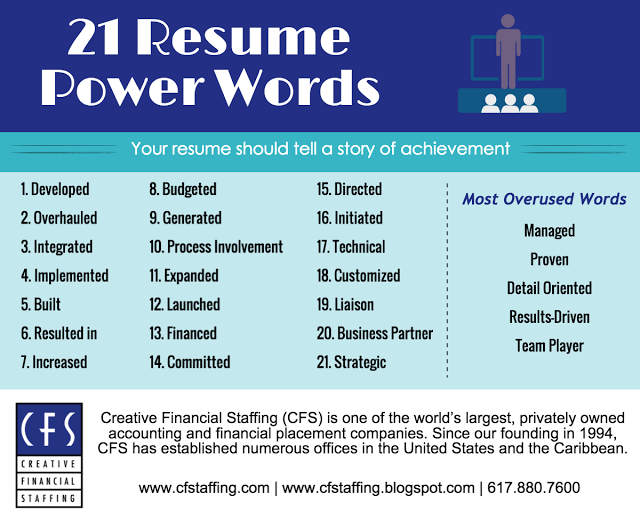
Power words to improve your resume
Networking for college students and recent grads
Networking for college students and recent grads

Are you a a college student looking for an internship or a recent graduate looking for a job? Our expert recruiters can help! Click here to find the closest location to you.
The ultimate Linkedin cheat sheet
The ultimate Linkedin cheat sheet
Our ultimate Linkedin cheat sheet will help you quickly create the perfect Linkedin profile, maximise your online visibility, build your contact list or get contacted about a new job. Whether you’re looking for slight improvements or starting from the beginning we’ve got you covered!
Did you know a person with a fully optimised Linkedin profile is 40 times more likely to receive job opportunities via Linkedin?! It’s probably a good idea to get a sneaky head start over the job market. After all you are competing against over 350 million users…
See more here:
http://www.leisurejobs.com/staticpages/18285/the-ultimate-linkedin-cheat-sheet/
Tips for your perfect interview

What makes a job seeker stand out via CFS
What makes a job seeker stand out
You submitted your resume and landed the interview, but what next? As you research the company and prepare for commonly asked interview questions, you must ask yourself one thing: How can I make myself stand out? Luckily, some of our expert recruiters here at CFS have some tips to help you do just that.
Be Professional
Have you ever heard the phrase, “You only have one chance to make a first impression?” This saying couldn’t be any truer when it comes to interviewing for a job. It is crucial to arrive 5-10 minutes early and to dress professionally. Our recruiters cannot stress that enough! This means a suit or a dress. Jeans are not acceptable. In addition, have multiple copies of your resume and a notepad and pen to take notes with.
Be Personable
In an interview, you need to turn the interview into a conversation. Ryan Glick, Executive Recruiter of CFS Shelton, remembers people who he connects with on a deeper level. It’s not just about proving that you have the skills necessary to do the job, but that you can fit in at the company. Ryan advises to not only speak about the position but to also be personable.
Be Able to Elaborate
It is crucial to be able to explain yourself. You need to answer each question with poise and provide strong examples with strong details. The interviewer has already read your resume, so now is the time to expand upon your qualifications. Now you can really delve into what you are looking for, why you want the job, and what you can bring to the company. This is your chance to put a face to the name and make a lasting impression.
Diane Lemaire, Senior Managing Director of CFS Houston, highly recommends creating a story with your answers. Be careful not to ramble though. The goal is to create a visual in the interviewers mind. Diane adds that the interviewer wants to be able to picture you at the desk doing the job. If you can accomplish this during your interview, you will have a distinct advantage over other candidates.
Stable Background
The duration of employment under your work experience stands out to a recruiter or hiring manager. Yes, working for a strong company is an added bonus, but a proven track record of staying with a company truly stands out.Randy Schwartz, Branch Manager of CFS Nashville, says that staying with a company and making changes when it advances your career is noteworthy. If a candidate has long-term goals, knows the steps to achieve them, and makes the decisions necessary to do so then they will be successful.
On the other hand, if a candidate has held many different positions in a short period of time, then a recruiter or potential employer will question their loyalty. They will question how long you’ll want to stay at their company and hesitate when it comes to hiring you.
Have Questions
This is a great way to stand out! The question segment of the interview typically allows you to prove that you’ve done your research on the company and is essentially your time to shine. While you should ask some questions that illustrate your knowledge, don’t ask these questions because you have to. Ask uncommon questions as well. An interviewer will remember someone who asks unique questions and will appreciate your intellectual curiosity.
Strong Communication Skills
Aside from interviewing well, you must communicate via email/phone in a professional manner as well. Coleen Trombley, Managing Director of CFS Hartford, says that getting back to your recruiter/interviewer helps you stand out. Taking that extra effort to respond quickly and give feedback to your recruiter will set you apart from other candidates who are not as efficient.
Send a Thank You
Now that the interview is over, it’s time for the Thank You card. Mike Ruben, Managing Director of CFS Fort Lauderdale, says that sending a Thank You note is a crucial step that many candidates commonly overlook. An email is perfectly acceptable, but if a candidate sends nothing then they hurt their chances. If the decision comes down to someone who sent a Thank You and someone who didn’t, the recruiter will lean heavily towards the one who did. In addition, this note is your last chance to solidify why you are the best person for the position. Who wouldn’t want that chance?!
Have questions about how you can stand out in your job search? We want to hear it so comment below! You can also reach out to one of our expert recruiters. Find the closest location to you here.

5 Signs of an Outdated Resume Written by Alan Carniol
Remember that your resume is your personal brand! You are unique. Do not send a “canned” version of your resume! You want to stand out. I love when I see a LinkedIn address on a resume too!
5 Signs of an Outdated Resume
Written by Alan Carniol
http://www.interviewsuccessformula.com/job-search-advice/5-signs-of-an-outdated-resume.php
Now more than ever, the world is constantly changing. There are things that we do today that may not be the best way next week or next month. Like other things in life, the interview and hiring process is in flux. There are things that weren’t accepted before that are now expected, and if you’re not willing to adapt, you’ll be left behind.
One of the things that have changed over the years is resumes. Some of us have had difficulty keeping up with the changes in the modern resume. These are some of the signs that you may need to seriously consider updating your resume:
You’re still using an objective – Objectives are one of the most outdated parts of a resume. The focus of a company is to understand what you can do for them, not what you want for yourself.
Even better, consider using a headline instead. Why? Because it shows that you’re a confident individual rather than someone who is unsure of him or herself.
Written with pretentious words – Every job seeker wants to stand out, but using words to try to look like someone you’re not won’t help your cause. You have to keep it simple while also adding a little bit of personality to it.
Outline of positions without specific achievements – One reason why resumes have changed is because they don’t offer enough information to help an employer with their decision. It only shows what your previous positions and responsibilities were, while failing to explain what you accomplished.
Too simplistic – The old adage is that simple is better, but today when you want to stand out, keeping it simple might not be enough. Using font styles that are a bit more modern and avoiding decades-old layouts might be a good idea.
Too much old information – What’s important is what you did in the past two to four years, not what you did a decade ago. While those experiences will help you, what you’ve been doing recently is what matters most for an employer.
The difference between a good resume and a great one lies in subtle changes that can go a long way in gaining the attention of an employer. Being aware of these changes can help you get more interviews for the job you want.
Here are some other links:
http://www.job-hunt.org/personal-branding/stronger-resume-branding.shtml
8 Reasons You Should Consider Hiring a Job Hopper By Mark Wilkinson
8 Reasons You Should Consider
Hiring a Job Hopper
By Mark Wilkinson
1. They are risk-takers.
Deciding to embark on a new career, within a new company, is a risk.
Will I fit in? Will I be able to do the job? Will the management team like me?
The “easy” option would be to stick with what you know (unless what you know is truly terrible).
So by definition, your job hoppers are actually a lot more likely to be risk-takers and apparently, smarter than your average Joe too!
2. They must be adaptable.
 Across different companies, your job hopper will encounter a variety of different people and will be asked to complete a variety of different tasks.
It’s therefore pretty essential that they can adapt – to different people, company cultures and roles.
So, if you’re looking for someone who gets stuck in to everything and who gets on with most people, the job hopper could be right choice for your business.
(Of course, if they only ever stick around for a couple of months and haven’t got any employment references, then the complete opposite could be true, so be wary!)
3. They’ll have a variety of skills.
Even companies in the same industry will use different strategies, programs and techniques to get things done, which means your job hopper will have picked up a variety of different skills.
(From simple things like CRM systems to entirely different ways of working).
Your job hopper will be a keen learner and could bring some fabulous skills and techniques to your business.
4. They know people.

You never know when a job hopper’s own network will come in useful!
From their previous clients and employers to colleagues and suppliers, you’d be surprised how many useful connections one person can build.
(And because they’re adaptable, they’re likely to have good relationships with these people.)
5. They’ll bring new ideas.
Your job hopper will be able to bring a wider variety of new ideas to the table.
Perhaps they’ve used a better CRM system, have used various research tools and techniques, have trialled a variety of agencies or products etc.
The knowledge they have gained across different companies could improve your own processes!
6. They’re ambitious.
 The most common type of job hopper is one who keeps leaving for bigger and better things.
When they feel they’ve gone as far as they can at their current workplace and that there’s nothing left on offer, they move on (this is a common behaviour amongstmillennials).
Of course, ambitious employees are much more likely to be enthusiastic about making a difference to your business (and making a name for themselves in the process).
Job hoppers know what they want and they aren’t afraid to go get it!
7. They’re not lazy.
I’ve heard many recruiters call job hoppers lazy… but I’ve never actually found that myself.
Think about it; looking for, securing and starting a new job is definitely not easy; in fact, job hunting is pretty much a full-time job these days.
As such, I tend to find that job hoppers are more proactive, enthusiastic and ambitious – how else would they have to energy to re-write CVs, attend interviews and change careers?
Sticking with what you know is certainly less effort.
8. It’s all relative, anyway!

Does it even really make a difference if a candidate is a job hopper? Is it fair to pigeon-hole them?
At Coburg Banks, we think everyone should be given the benefit of the doubt.
If you’re unsure then ask the question; find out whythey’ve left other businesses – they may just have been unlucky and not found their dream company yet – you’ll never know if you don’t ask.
Don’t risk losing a great employee, for the sake of an old stereotype.
Of course, there is always a downside…
The 8 reasons I’ve outlined above are all based on trends I have personally picked up on (and a bit of common sense) but of course, you will occasionally just come across a bad egg!
Recruiter Pro Tip
Here are some warning signs that your candidate could be one of the “bad” job-hoppers:
- They don’t have any references from previous companies (are they a trouble-maker)?
- They regularly flit between careers and industries (do they actually know what they want)?
- They don’t have a reason for leaving their current job (do they just get bored)?
…use your gut instincts and probing questions to suss these things out!
If you’d like to read more about attracting a recruiting good egg, click here to subscribe to this blog; we’ll send over a quick weekly update with the latest industry news and advice!
10 Killer Interview Tactics You Ought To Know!

9 steps for figuring out which skills to include on your résumé By Rachel Gillett
9 steps for figuring out which skills to include on your résumé
If you’re sitting in front of your computer, wracking your brain trying to come up with skills to add to your résumé, fear not.
With the help of some career experts, you can easily — and honestly — pad out your résumé with key skills recruiters look for.
Here’s how:
1. Consider some of the most common skills recruiters search for.
“The most common skills people forget to showcase are the transferable skills that recruiters use general search terms to find — things that can be measured,” says J.T. O’Donnell, a career and workplace expert, founder of career advice site,CAREEREALISM.com, and author of “Careerealism: The Smart Approach to a Satisfying Career.”
These include:
- Software you are proficient in (MS Word, PowerPoint, Excel, Office)
- Project Management
- Marketing
- Sales
- Customer Service
- Budgeting
- Recruiting
- Management
2. Specialize your skills.
The skills recruiters look for when they scan through résumés depend on the type of position they’re trying to fill, says Rita Friedman, a Philadelphia-based career coach.
For example, if you’re applying for a position that requires technical knowledge, include specific examples of technology or equipment you use, even if it could be reasonably assumed you must know these things, Friedman suggests.
3. Scan through a ton of job postings.
“To ensure that you’re including relevant information on your résumé, carefully review job postings and highlight the parts that make you say, ‘Oh, I do that all the time!'” Friedman suggests. “When you’re writing your own resume, it can be hard to be objective, and you may forget about things that you’re so good at doing they come to you automatically.”
4. Research people with the jobs you want.
Friedman and O’Donnell both suggest checking out the LinkedIn pages of people whose jobs you’d like. Check out their “Skills & Endorsements” section and identify which ones you could justify putting on your profile too.
5. Diversify your list of skills.
“When evaluating a résumé, recruiters are looking for two big qualities: hustle and curiosity,” says Kate Swoboda, creator of the Courageous Coaching Training Program.
She says employers today are looking for résumés that demonstrate the person takes initiative and is motivated by curiosity.
“These days, coders are now expected to interact with clients, and the person in charge of crafting the company’s next great tweet might also be called upon to help with some aspects of visual design,” Swoboda explains. “Recruiters are looking for people who are curious enough and motivated enough to go beyond their technical job description because that adds more value for a company.”
6. Don’t be afraid to make it personal.
“I’m very much in the camp of not hiding your personal life, skill set, and interests from a prospective employer,” says Michelle Ward, a creative career coach and co-author of “The Declaration of You!“
She suggests including skills you’ve learned from outside passions, whether that includes owning an Etsy shop or planning your best friend’s wedding.
“I think, more and more, companies want to see a well-rounded, inquisitive, personable candidate that is right for the job and would be someone interesting to have in the office,” she says. “Just make sure to relate that experience back to how it’d be value for the company/position you’re applying for.”
7. Consider what you’re proud of.
Friedman suggests you make a list of the things you’re especially proud of accomplishing in your jobs and then think about what skills you used to accomplish these.
“If you reduced the amount of time it takes to complete a task, you may have strong skills revolving around process improvement or automation,” she says. “If you got back the business of a former client who left, you may have a talent for repairing damaged relationships.”
Ward adds that you should ask yourself, “What do people thank me for? What do I get complimented on, repeatedly?”
8. Quantify your skills.
Before you add any skills to your list, O’Donnell suggests you ask yourself a number of questions like:
- How many projects have I led?
- How many people were on the team?
- How many customers were affected by my work?
- How many people did I train?
- How much money was involved?
- What kind of results/savings did I get?
“If you ask yourself enough of these, you find your way to validate and quantify your experience in a way a recruiter can understand,” she says.
Friedman agrees and says it’s always better to show rather than tell on your résumé.
“For example, if you’re in sales, you don’t just need to hit keywords like ‘business development’ or ‘consultative selling;’ you need to have quantifiable examples of your skillset in action: ‘Increased sales over previous year by 63%.'”
9. Talk it out.
In determining if you have the skills necessary, when creating a résumé, talk about your experiences out loud with someone, preferably a professional or someone who has work experience,” suggests Alyssa Gelbard, founder and president of Résumé Strategists.
“They hear things differently and can help you translate your internships, jobs, extracurricular, and educational experiences into important skills for a potential job.”
100 Essential Questions That Will Change Your Career Path (for the Better) via www.inc.com
100 Essential Questions That Will Change Your Career Path (for the Better)
These 100 questions will help you understand where you are in your career versus where you want to be and help you to identify actionable steps towards making a powerful vision a reality


Job Search Tips for the passively seeking, actively searching and unemployed
Job Search Tips for the passively seeking, actively searching and unemployed
Facts:
- Number one rule: 20% of all jobs are advertised, 80% are not!
- Job searches have become more difficult, but not impossible. If you are unemployed, you need to treat your search as a full time job. You have to be able to work your network and get creative. The jobs are not going to come to you.
- Average search time for a position is 2 to 6 months.
Tips:
- Join http://www.linkedin.com. This is a great professional networking website. Link up with me here: http://www.linkedin.com/in/dianedelgadolemaire
- Utilize http://www.indeed.com to set up job search agents.
- Check my blog for the most updated list of our openings: dianedelgadolemaire.wordpress.com
- Don’t forget about the classified ads in the Chronicle and Houston Business Journal.
- Make sure you always have the most updated copy of your resume close by. You just never know!
- Unemployed? Email everyone in your address book your resume and ask them to forward it on to their friends.
- Update your Facebook status to let people know that you are looking for a position.
- Volunteer your time. Meet new people! Join an organization you are passionate about.
- Join networking groups or become a member of various professional organizations.
- Go to CPE luncheon meetings! Network with fellow accountants, auditors, etc.
- Make sure you consider temporary jobs. They can open up doors as well.
- Use Twitter to let people know you are looking: http://www.twitter.com. You can follow me at @CPARecruiterHOU
Diane Delgado LeMaire
Senior Managing Director, Executive Search & Branch Manager
Creative Financial Staffing (CFS)
5718 Westheimer Suite 800, Houston, Texas 77057
T: 713.490.6003 | dlemaire@cfstaffing.com | http://www.cfstaffing.com |
10 Daily Habits of the Most Confident People Stay motivated and confident in 2016. BY CHRIS DESSI
10 Daily Habits of the Most Confident People
Stay motivated and confident in 2016.

IMAGE: Getty Images
I’m not here to patronize you. We know if you walk with better posture, force a fake smile, or get a new haircut you can trick your brain, and boost your self-confidence. Perhaps for 20 minutes you’ll think you’re the next Richard Branson.
I’m here to tell you there are proven ways to improve your self-confidence that will drive real, long lasting change in your life.
1. Meditate
When we feel insecure it manifests itself in myriad ways. Our bodies don’t work. We can’t focus. Insecurity creeps when we’re not living in the present moment.
Taking control of our monkey brain is a profound step toward true self-confidence. I recommend you try the Headspace app. You can select 5 minute, 10 minute, and 20-minute simple guided meditations.
2. Think inside the box
Having the freedom to make choices with your time might be one of the main reasons you decided to become an entrepreneur.
Too many options can be your downfall.
We speak it platitudes that we think carry weight–like “think outside the box.” There is a freeing joy in thinking inside the box. Executing on what you know, focusing and moving the needle are empowering.
3. Learn something new everyday
The average audio book is 10 hours. If you commute 60 minutes a day, you can listen to about 24 books a year.
That’s a life changing habit. The more knowledge you have, the greater your confidence will be. Simple. Get Audible.com here.
4. Teach
If you’re an expert in your field, sharing your knowledge will add to your fulfillment as a human being. Feeling fulfilled will add to your confidence.
If public speaking terrifies you, consider posting content on platforms like LinkedIn or Medium. Or you can create an online course on Teachable.com.
5. Take Control of Your Career
The best way I know how to do this is to launch your own personal blog. I recommend the URL be: First name, last name DOT COM.
It’s a simple notion. If you take control of your personal brand, create content that inspires you, confidence will follow. If you’re ready to launch your blog, than you canstart here. I created a 24-step tutorial that shows you how to do it in 15 minutes.
6. Exercise
Instead of buying expensive clothes, you can workout. Clothes will fit better. Instead of trying to walk with your shoulders back, exercise. Your core muscle strength will enhance your posture and gait.
Instead of buying skin products, exercise and hydrate. Your skin will look better. Instead of forcing that fake smile to make you feel happier – exercise. The Mayo Clinic says “You may also feel better about your appearance and yourself when you exercise regularly, which can boost your confidence and improve your self-esteem.”
7. Get more sleep.
If you have trouble sleeping, try the app called Sleep Cycle. Getting enough sleep helps your brain and body. The Harvard Mental Health Letter states: “The deepest stage of quiet sleep produces physiological changes that help boost immune system functioning.”
Sleep Cycle helps you see when you fall into the deepest, most healing stages of sleep. It wakes you with a gentle chime that wakes you at your peak awakeness cycle. Better sleep, sharper mind, better mood, and greater self-confidence.
8. Volunteer | Give Back
I used to volunteer at the Den for Grieving Kids in Greenwich CT. September 11th happened. My fellow volunteers became my support network.
I thought I was giving. I thought I was sacrificing. All the love I cold conjure couldn’t match the love I felt from that group in the weeks and months after September 11th. Who knows, you may heal someone, and you may heal your own soul.
9. Socialize
This can be a difficult one for introverts. Socializing, or finding your tribe, doesn’t always have to happen in person. Levering an online community of like-minded people can enhance your self worth.
Abraham Maslow’s hierarchy of needs includes belongingness among essential human needs. Contributing on Quora, or posting compelling content to your network on LinkedIn can create a real sense of belonging. Similarly, building community via your Twitter account can also stimulate this powerful feeling.
10. Get Curious
Seek people who are more experienced than you. Learning from them will instill a powerful calm of knowing. Chances are, the lessons they share will be invaluable.
Most “overnight success “stories have experienced trials and tribulations that you may be experiencing. They have all survived, and may be able to help you.
December 2015 Newsletter for Accounting Professionals from Diane Delgado LeMaire @ CFS
December 2015
Industry News and Updates:
Let me just jump right in and address the question that is going through everyone’s mind: What is going on in the Houston job market? I get this one daily and I must admit it is not an easy question to answer. I would like to share some data that I learned about at a recent forum (Bauer College of Business – Institute for Regional Forecasting) I attended and then share my thoughts at the end. The title of the Forum was: Houston’s Job Growth Stumbles As Oil Markets Swoon: Where Now? That doesn’t really set the tone for a positive outlook, does it? Here are some of the highlights:
- It’s all about oil! Price is down by 50%. Eventually this trickles down and impacts all sectors; even retail! BUT construction, education, healthcare, and home building are still doing well.
- In 2015, we virtually had 0% employment growth in Houston.
- This is NOT 1982! But we do have a supply / demand issue and that is what is pushing the price of oil down.
- The greatest oil boom is over for now.
- The professional and business services sector have not been impacted yet.
- One operating rig actually creates 227 jobs (direct and indirect)!!!!!!!
- Houston is undergoing a mild recession. Best case scenario we come out in mid-2016, but it looks like 2017 is more likely. Worst case scenario this drags out until 2018.
That is what I learned and here is MY opinion… I think there are many sectors in Houston that will be hiring. Our office is seeing demand in a lot of different industries and at a variety of levels. Is this the summer of 2014? No, and it will not be for a while. The Houston economy goes through business cycles just like everyone else. While most of the US was still in the midst of the Great Recession, Houston was booming. Well, it’s not a BUST for Houston for now, but we will be hurting a little bit in the near future. Companies are going to try and get by with less overhead. They are going to consolidate positions and they are going to have to lay off, unfortunately. The good news for you is that you are an accountant! There is always a need for accountants!!!!! Also, Houston is still at a 4.8% unemployment rate (September 4.4, October 4.6). We are still at full employment and there are plenty of people nearing retirement age. The jobs are still out there, however, they are not as easy to find and you may have to be a little bit more flexible with what you are looking for. So, my verdict? I am cautiously optimistic about 2016, but I am really looking forward to 2017!!!!!!
See you again in February 2016!
Local Statistics:
- National / Houston Unemployment rate: 4.8/4.8
- Price of Oil:$38ish (last year $75)
- Oil Rig Count:760 (last year 1925)
- Industries hiring: Manufacturing, Construction, Consumer Products related companies, Real Estate, Public Accounting Firms!!!!
- Positions in demand: Tax, Auditors, Financial Analysts, Staff and Senior Accountants
Interesting Articles:
- How your desk evolved in the past 35 years: http://wp.me/puDjI-Zv
- How to beat interview nerves: http://wp.me/puDjI-Z9
- 15 ways to make sure I do not hire you: http://wp.me/puDjI-WD
Local Searches:
- Manager of Statutory Reporting – International
- Public Accounting: Tax and Audit – All levels!
- Accounting Supervisor – NW Houston – Lead ready to take on form supervisor title!
- AR Specialist – 50 to 55K West – non degreed role!
- Accounting Analyst – Conroe
- FP&A Manager – SE Houston – MBA A MUST
- Division Assistant Controller – West – Must have 2 to 4 year of Public Accounting!
- Accounting Supervisor – NW Houston
- Inventory and Operations Accounting Director – West
- Senior Financial Analyst – Salt Lake City, UTAH – right hand person to VP/GM
- Tax Accountant – West
- International Tax Accountant – North
- Financial Analyst – CPA who wants to do finance!
- Bilingual Auditor!!!!!
- Senior Auditor for Public Accounting
- Tax Supervisor – CPA Firm – are you a senior ready for the next step?
- Financial Analyst – Modeling experience – Senior Role
- Division Assistant Controller – 3 years of public accounting
- Senior Accountant – 3 years GL experience – Galleria
- Division Controller – regional role…work with several locations and report to CFO of Americas…heavy operations focused
- Sales & Use Tax Analyst
- Associate Manager / Manager – Professional Services Firm – Consulting on high profile projects – full time role – need at least 2.5 year of public accounting and maybe a splash of industry to qualify! This is for those who want to build a resume that will get them to the next level quickly!
- ONRR Manager – want to work for one of Houston’s best?
- Sales & Use Tax Accountant – huge global company!
- Credit & Collections Manager – Spanish!!!!!
- Audit Senior – low travel
- Senior IT Auditor – 2 openings!!!!!
- Financial Analyst – SALT LAKE CITY – who wants to move to UTAH?
San Antonio Searches:
- University Controller
Diane Delgado LeMaire
Senior Managing Director, Executive Search & Branch Manager
713.490.6003 | dlemaire@cfstaffing.com
www.linkedin.com/in/dianedelgadolemaire/
https://dianedelgadolemaire.wordpress.com/
www.facebook.com/CPARecruiterHouCFS
How to Nail the Interview and Find Your Pot of Gold Written BY Kathi Miller-Miller
How to Nail the Interview and Find Your Pot of Gold
Written BY Kathi Miller-Miller
image: http://bullseyerecruiting.net/wp-content/uploads/2015/12/GoldRush.jpg
 During a recent trip to Alaska, I was intrigued by the long and rich stories of the “Gold Rush” expeditions. In the day treasure hunters went to extreme lengths, often risking personal injury to find a treasure that would literally transform their lives.And I started thinking that it’s really not much different than a job search. Sure you aren’t mining for real nuggets of gold, but nonetheless you are a treasure hunter going to great lengths and risking personal injury (albeit emotional!) as you look for job opportunities.
While you’re engaged in the hunt, chances are good that you pass by some finds dismissing them as either too small or not “pure” enough to reach your goals. But just when you start thinking you’re never going to find your “pot of gold,” you get a call for an interview for the job of your dreams! At last the chance to claim your treasure.
But before you get too carried away with interview prep, it’s important to understand that your ultimate goal in the interview isn’t to get the job. I know that’s crazy right?!? Instead your goal is to figure out if you WANT the job. And the best way to do this is by asking questions that help you determine if the position really is the “treasure” you think it may be.
In my years of coaching and candidate selection, I’ve told virtually every candidate the interview is as much about their opportunity to determine if we are a fit for them as it is about me. Yet when I ask what questions they have, most candidates either numbly reply “no” or maybe ask about a timeline for the decision. But that’s it.
Instead, ask a few of the questions below to determine if the opportunity is really your “pot of gold:”
Questions to Get Insights About the Boss:
 1. QUESTON: Tell me about a top performer on your team. What does he/she do differently?
GOAL: To learn what skills/accomplishments are required to be a recognized team leader.
2. QUESTION: What did your team recently accomplish that made you proud?
GOAL: First, to let the hiring manager brag about a recent accomplishment which is never a bad move, but this question also provides insight about what it takes to impress them.
3. QUESTION: How would you describe your communication and management style?
GOAL: Here you’re looking to learn how much they will/won’t be in your business and how easily you can adapt to their style. For example if you are soft-spoken and concerned about hurting others feelings, working for someone with a direct communication style may not be a great move.
4. QUESTION: What will be your biggest challenge in the next 12 months?
GOAL: By learning their challenge, you should gain a pretty good idea of ways you may be able to add value to the team. And there is also a good chance you’ll learn a bit about enterprise efforts and company direction.
5. QUESTION: What will be the most important criteria in your candidate selection?
GOAL: Ideally after asking this question you want to find a way either immediately or during follow up to demonstrate your proficiency with the most important criteria…assuming the job is your “pot of gold!”
Questions to Ask to get Insights About the Job
1. QUESTION: If I was offered the job, what would be my biggest challenge?
GOAL: This question helps you spot difficulties such as work load; personality issues and skill gaps.
2. QUESTION: Would be possible to see some examples of the work I would be expected to complete?
GOAL: There’s no easier way to see if you will enjoy the work you’re expected to complete than seeing examples. It also allows you to be confident that you can perform at the expected level.
3. QUESTION: How much travel is expected?
GOAL: While some folks love travel on the company dime, others prefer a more traditional office environment. Asking this question ensures you know what you are/aren’t getting into.
4. QUESTION: What does a typical week look like here?
GOAL: This question allows you to gain a glimpse of life on the “inside.” For example if you learn that most of your days will be spent in meetings or team projects and both of those make your eyes glaze over, a “treasure” it’s not!
5. QUESTION: Would it be possible to meet the team members as a part of the screening process?
GOAL: A huge part of your work satisfaction is dependent upon co-workers and having the chance to meet the team allows you to see how comfortably you can/can’t work together. It also allows you to gauge the age, sex and experience of those you will be joining.
You see, the concept of finding a treasure (aka pot of gold) is something special. And finding a job where you are engaged (and maybe even LOVE!); co-workers who you enjoy; finding purpose in your life and maybe even the chance for further career growth doesn’t just happen. Asking a few of these types of questions during your interview helps you easily sort out the gold from a shiny new opportunity that quickly dulls.
As an added bonus, the recruiter will likely enjoy the dialogue, the chance to talk about themselves and their responsibilities and just maybe offer you that “pot of gold” with a job offer!
Best of luck and I’d love to hear from you. What is the best question you’ve asked during an interview?
 Kathi Miller-Miller is a sought after career specialist and author of “Your Journey from Fired to Hired.” Kathi draws on her 25+ years of success (and failures!) to offer her readers advice on topics ranging from dealing with a boss that drives you crazy to managing millennials…all in a light-hearted and easy to read style. Feel free to visit her at www.kathimillermiller.com where you can engage in the conversation, check out past posts and subscribe to her monthly newsletter.
Read more at http://bullseyerecruiting.net/how-to-nail-the-interview-and-find-your-pot-of-gold/#XTXhQo8V7yso8Eh5.99
Success Monday!
Check out these articles:
- Bill Gates Says These 5 Traits Guarantee Success
http://www.inc.com/minda-zetlin/5-success-mindsets-bill-gates-wants-you-to-learn.html?cid=sf0100
- The most important, yet overlooked management skill
https://getlighthouse.com/blog/management-skill
- A Navy SEAL’s Secret for Pushing Yourself Way Beyond Your (Supposed) Limits
- 5 Ways Learning Sales Can Help You Reach Success
http://addicted2success.com/success-advice/5-ways-learning-sales-can-help-you-reach-success/
15 ways to make sure I will NOT hire you by Greg Savage
15 ways to make sure I will NOT hire you
by
This is not ‘career advice’. I am no ‘job search guru’. This is not scientific, empirical or out of your latest HR manual.
But I have interviewed more people for jobs than you have*, and I am acutely aware of what annoys me, frustrates me, and inclines me to think negatively about a candidate.
This is simply a list of what ticks me off. And I like to hire people who do not tick me off. So, in that sense, these are facts. I suspect it is a very similar list for most interviewers.
- Arrive late.
- Dress like you going to a rave, the beach, or the cricket.
- Bring your coffee, diet coke, or whatever else into the interview room.
- Put your phone, your folder, or your keys on my desk, without asking.
- Call me ‘mate’, ‘buddy’.. or… no… I can’t write this… but I must… ‘dude’!
- Talk, and talk, and talk… and talk.
- Not answer the question put to you.
- Have no questions for me.
- Interrupt me and second-guess what I am about to say.
- Answer a question with “It’s in my résumé”.
- Answer your phone. In fact don’t touch it or even look at it. Actually, I don’t want to see it.
- Tell me what an idiot your previous boss was.
- Swear.
- Not laugh at my jokes. (That one was a joke. But, just checking, are you laughing?)
- Not thank me for my time. Especially as I will have thanked you for yours.
Now before anyone gets overexcited about the outrage of not hiring someone just because of just one minor misdemeanour, take a chill pill. I know better than most how to overcome the inbuilt discrimination we all bring to every assessment situation. I would never really disqualify someone on the basis of one random irritation. Or even two. I know how to assess and hire. But it won’t help you if you do these things. Not with me, not with most interviewers.
 Houston's F&A Recruiter and Talent Connector