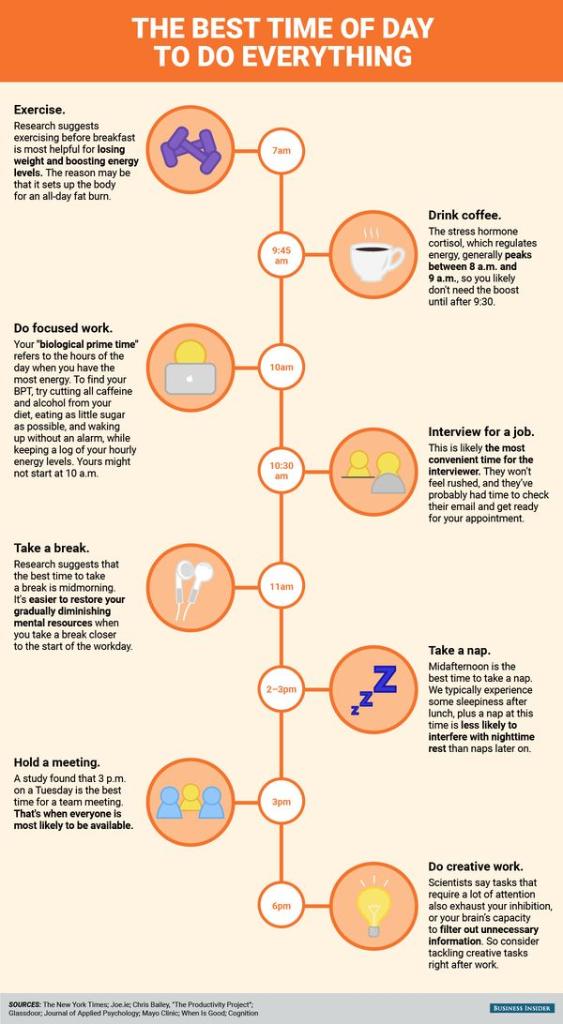
10 Ways to Boost Your Productivity at the Office-Article written by Lori Lynn Smith for Lifehack

10 Ways to Boost Your Productivity at the Office

Article written by Lori Lynn Smith for Lifehack

You stagger into the office five minutes before your are suppose to start, you have a coffee in your hand. You do like your job, but it is hard to hit the floor peppy and productive every single day. It feels even harder when you find yourself sitting for so long at one time. That is the nature of the job, but how can you change things up a little to create an environment that is more productive and more enjoyable?Here are ten strategies that can set the tone and keep you motivated to be productive:

1. Plan
Get to your desk about 15 minutes early and write out a daily list of tasks and plan out your day before it begins. This will help to keep you focused and on track throughout the day. Set out your top three most important tasks to do first.
2. Power hour
Commit! Dedicate the first hour to getting as much done as you can. Avoid your email inbox, favorite blogs, and voicemails, and get right to work. This sets the tone for the day and gives you a great sense of accomplishment that can follow you through to home time.
3. Recess
When we were kids we probably loved recess more than school, but our teacher knew that we needed small breaks to help us learn better. The same is true for working. Allocating specific time periods when it’s okay to become distracted can help make the rest of your day more productive. Just keep them short and then get back to it.
4. Time chunking
By shifting your focus between tedious and repetitive tasks and those that are more engaging, you can keep yourself more happily involved in your work throughout the day. Give each task category a time frame and alternate back and forth between them for best results.
5. Rock the clock
Rather than working on a project until it’s completed, resolve to work on a project for a set period of time, then change your focus. This will keep you productive and eliminate some of the tedium associated with working on the same project for long periods of time.
6. Organize your email
You can increase sanity by keeping your inbox organized, especially if you get a lot of correspondence on a daily basis. Use folders and filters to keep your email inbox organized and it will be as beneficial as having a tidy desk or cubicle. I personally like to strive for Inbox Zero: daily is great, but definitely by Friday afternoon.
7. Listen to music
Music can help you settle into your work routine. Low-volume music can drown out noises in the office without interrupting other people around you. Choose music that helps you focus without distracting you. It has been shown that while listening to Classical music your IQ actually increases—you might want to give it a try!
8. Drink up
Hydration is important for a variety of health reasons. Fill up a personal water bottle and keep it with you all day. Keeping a water bottle by your side will prevent you from having to get up over and over to get more water and ensures that you stay hydrated throughout the day. I love to use a 1 liter bottle, and drink one before lunch and one after lunch.
9. Leave your desk for lunch
Having a lunch break away from your desk can disrupt your productivity routine, but it does provide some much-needed relaxation and respite from your work. Enjoy your lunch break and return to your work with renewed energy and focus. Exercising during lunch, even if it is just a quick walk around the park, will also help to keep your energy up.
10. Keep it professional
Respond to personal emails and deal with personal phone calls on your own time. By clearly separating work and home, you can focus yourself better during the day to get more done. If you have important personal tasks that need to be done, use your break or lunch, but walk away from your desk.
Hit your stride
You can stay productive during work hours if you plan out your day and really think about what you’re doing at work. It doesn’t take much forethought to have a good workday, but the time you put into planning can pay off big time!

Read the original article posted on Lifehack.

Industry Roles for Public Accounting Professionals! dlemaire@cfstaffing.com

Featured Image -- 3330

We have several clients interested in public accounting Auditors and Tax professionals. Please email me at dlemaire@cfstaffing.com for more details.

List of Openings:

  • Internal Auditor, Downtown, 100 year old business, 40% travel, domestic & international
  • Senior Accounting Analyst, Med Center, Top 100 Employers in Houston
  • IT Auditor, Westchase, 7 Billion Dollar company over 50 years old
  • State & Local Tax Accountant, Galleria, Multi-Billion Dollar Energy Services Company
  • Federal Tax Accountant, Galleria, Multi National Manufacturing Company
  • Financial Reporting Analyst, DT Houston, Oil & Gas, Position open due to growth
  • Internal Audit Manager, Non Profit, Galleria, Start an Audit Department from scratch

Senior Auditor – Houston & Charleston, W.V. – dlemaire@cfstaffing.com

SENIOR INTERNAL AUDITOR

CPA (parts past) or CIA Required

Why take a Senior Internal Auditor role with this company?

  • Exposure to multiple business units
  • Key part of a newly created finance/compliance team
  • Opportunity to work domestically and internationally
  • Ability to grow within the internal audit department and/or move to other area of the organization

What the Senior Internal Auditor will do…

  • Financial audits (process, accounting, tax, controls, corporate finance, compliance)
  • Assist in developing and implement audit principles, programs and tools
  • Evaluate internal controls
  • Prepare Audit Reports
  • Analyze business processes

What the company needs in a Senior Internal Auditor:

  • Bachelor’s Degree in Accounting, Finance or a related field; CPA/CIA i
  • 3+ years of audit experience from a small or local CPA Firm
  • ACL expreince a huge plus
  • Ability to travel up to 40% domestically and internationally

Perks of the Senior Internal Auditor role:

  • Strong medical benefit package
  • Work for a 100 year old company!
  • 401-K with match
  • Tuition reimbursement
  • Exposure to all areas of the company’s finance infrastructure

dlemaire@cfstaffing.com


9 Powerful Affirmations Successful People Repeat Every Single Day By Jeff Haden

9 Powerful Affirmations Successful People Repeat Every Single Day
Successful people think about their work — and themselves — differently than most. And so can you.

How to: Write Your LinkedIn Summary Like a LinkedIn Influencer By Siofra Pratt

How to: Write Your LinkedIn Summary Like a LinkedIn Influencer

Posted  by Siofra Pratt

http://www.socialtalent.co/blog/how-to-write-your-linkedin-summary-like-a-linkedin-influencer?utm_source=twitterfeed&utm_medium=twitter


We trawl through and judge candidates on their LinkedIn summaries all day, every day trying to determine if they have what it takes to do the job we or our client needs them to do. But have you ever stopped to consider what a candidate might think of your LinkedIn summary if the shoe were on the other foot?

Many recruiters seem to forget that LinkedIn works both ways. While we use it to find, research and reach out to potential candidates, our potential candidates are also using it to scope us out once they know we’re interested.

“They are checking you out before responding to you. They are stumbling upon you as they network online,” saysKate Reilly in her LinkedIn blog on the topic. “If you consider your summary as a strategic piece of content that can work for you, you can improve your effectiveness as a recruiter”.

Which is why today we’re asking, if a candidate were to go looking at your profile (which they inevitably will), would they be impressed, inspired, intrigued, shocked, bored or annoyed by your LinkedIn summary? Does your LinkedIn summary do you justice? Does it compel potential candidates to respond to your communication with them? Or is it something you’ve even considered before now?

You have 2,000 characters with which to express your unique personal brand by telling people why you’re important and why they should pay attention and listen to you and what you have to say. So how do you go about mastering this particularly tricky piece of writing and more specifically how do you master it as a recruiter? Here are the Do’s and Do Not’s of writing your LinkedIn summary like a LinkedIn Influencer:

1. DO NOT… write your summary in the 3rd person

Sooooo many people (even those you’d think would know better) use this approach when it comes to their LinkedIn summaries! You don’t talk about yourself in the 3rd person in real life (or at least I sincerely hope you don’t), so why in the name of all that is good, would you want or try to do so on your LinkedIn profile?!

LinkedIn is a social networking site, and social networking is all about developing personal connections through conversation. And there’s nothing more impersonal or less conversational than referring to yourself in the 3rd person. Don’t do it. End of.

2. DO… tell your story

“The simple act of being on LinkedIn is marketing. Don’t be lazy and cut-and-paste your resume and expect people to be interested. Spend a little time and tell a story. It’s well worth your time and those reading your profile will appreciate the effort” says Mark Amtower, and according to him your story “should be designed to educate, entertain and illustrate your area of expertise, enticing people to reach out by giving them a taste of who you are and what you do”.

To do this successfully, Craig Rosenberg recommends answering the question “Who do I help and how do I help them?” When answering this question, William Arruda advocates that you pay special attention to the “who” you help. According to Arruda, the “who” refers to the decision makers you would like to impress and influence with your LinkedIn summery. In your case, those decision makers are your candidates. That’s why Arruda believes that in answering Rosenberg’s question, you also need to bear the following three questions in mind; 1. What do you want them to know about you? 2. What do you want them to do? 3. How do you want them to feel?

My professional mission as a content writer is to create valuable, shareable content that helps recruiters do what they do better and faster. I’ve answered Rosenberg’s question by stating that I help “recruiters” and that I help them by creating “valuable” and “shareable” content that helps them “do what they do better”. As a tech recruiter, your professional mission might be to help talented UX Developers realise their own professional goals by finding them their next challenge in the company that’s right for them. You’ve identified that it’s UX Developers that you help and you help them by finding their next challenge with a company that suits them.

Check out some of the professional mission statements these recruiters have made in their LinkedIn summaries for example:

linkedin summarylinkedin summary

The next thing you need to do is elaborate a bit further on your professional goal and get specific about how you go about trying to achieve your professional goal.

For example, Rachel states that she takes “pride in ensuring that placements are a strong match for all parties” and that she’s “interested in finding people careers rather than simply jobs”.

Craig tells us “partnering with my leaders to help them think differently and coaching the talent I work with to attain the unattainable is what motivates me to continuously improve in this ever evolving industry”, and that he spends a considerable amount of time “driving key initiatives at CommBank from LGBTI to gender equality to creating greater cultural awareness”. Craig’s passion for what he does as a recruiter is palpable, and any candidates reading his summary will be able to see that clearly, making them more likely to respond to his communications with them.

3. DO NOT… ramble

It’s called a summary for a reason. This is not your personal memoir in which you try to list everything you’ve ever done, every job you’ve ever had, or every achievement you’ve ever been awarded. The aim is simply to tell people why you do what you do and how what you do can be of value to them. So, keep it short and to the point. And asKate Reilly says, “don’t use a five-syllable word when you can use a one-syllable word that is just as good. Keep your words, sentences, and paragraphs tight.” We suggest 250 words or less.

Oh, and your LinkedIn professional summary is no place for mentioning your family, your pets, or your penchant for water skiing (unless of course you recruit water ski instructors), so please don’t include them. Keep that stuff for Twitter, Facebook, Tumblr, Instagram, Snapchat… anywhere except LinkedIn!

4. DO… include a strategies section

“To improve your standing when candidates search LinkedIn and Google, you’ll want to include keywords that highlight your top skills. One approach is to list your ‘Specialties’ at the end of your summary,” says Kate Reilly.

Including a specialities section in your summary gives you the opportunity to include all of the keywords you want to be associated with in your profile, which will then make it easier for candidates to find you when they perform a keyword search online:

LINKEDIN SUMMARY

5. DO NOT… use self-indulgent buzzwords

When J.T. O’Donnell shared with the readers of the Careerealism blog what she dubbed “The Worst LinkedIn Summary”, it read like this:

linkedin summary

Why did O’Donnel dub this the worst LinkedIn summary of all time? She says it’s because each and every claim made in this summary (e.g. “dynamic and high spirited leader”, “highly organized individual”, “highly adaptable” etc.) is completely subjective and unsubstantiated by any actual evidence that the person possesses those qualities. Oh, and because the summary is littered with overused buzzwords! In fact, this summary alone contains 3 of the Top 10 Most Overused Buzzwords on LinkedIn Profiles

“Stay away from buzzwords and empty phrases,” warns Kate Reilly. “Words such as ‘motivated’ and ‘driven’ are so overused they lose their significance. Cross-check your summary with the most overused buzzwords on LinkedIn profiles and tap your thesaurus for alternatives”.

6. DO… end with a call to action

You’ve impressed the candidate with your professional mission and you’ve convinced them of the value you’ll bring to their career, but what do you want them to do now?

Always end your summary with a solid call to action that tells the candidate what to do next. If you’d like them to get in touch with you, direct them to the best way to do that e.g. phone (include your number), email (include your email address), InMail, Twitter (include your Twitter handle), or if you specialise in tech recruitment for example, ask them to connect somewhere where they might feel more comfortable like Stack Overflow or GitHub.

7. DO NOT… neglect formatting

“People have short attention spans and many will skim your text. So steer clear of long dense paragraphs,” says Kate Reilly, which is why the marketing whiz kids over at Hubspot, suggest that the best way to format your LinkedIn summary is using the 3X3 rule – three paragraphs with three or fewer sentences each.

  1. The first paragraph should state your purpose or your professional goal i.e the first part of telling your story as discussed above.
  2. The second paragraph should be used to elaborate on how you go about achieving your professional mission.
  3. The last paragraph should include a concise call to action that makes it very clear to the reader what they should do next to get in contact with you.

Your specialities section should be located below these three paragraphs.

Conclusion

6a0120a530561e970b017ee7ed4787970dSo, in order to create a LinkedIn summary that a LinkedIn Influencer would be proud of, be sure to do the following:

  • Write your Linkedin summary how you speak – in the first person.
  • Tell your story – explain to your specific audience why you do what you do and how you can help them do what they do.
  • This is a summary so keep it short and to the point – steer clear of buzzwords.
  • Always end with a call to action that tells the candidate what they are to do next.
  • Format your summary by utilising the 3×3 rule – and don’t forget to include a separate “Specialities” section to house your keywords.

Internal Audit Manager – Houston, Texas – dlemaire@cfstaffing.com

The Internal Audit Manager is responsible for monitoring and updating the organizations risk assessment, preparing and monitoring an annual audit plan, and executing the audit plan.  The Audit Manager will manage a team of internal and outsourced auditors.

Areas of Responsibility and Essential Duties include:

  • Maintains and annually updates the organizations Risk Assessment.
  • At least annually updates an Internal Audit Plan.
  • Creates, monitors, and tests all internal controls.
  • Guides internal audit decisions by establishing, monitoring, and enforcing policies and procedures.
  • Monitors and confirms financial condition by conducting audits; providing information to external auditors.
  • Achieves budget objectives by scheduling expenditures; analyzing variances; initiating corrective actions.
  • Prepares internal audit reports by collecting, analyzing, and summarizing internal audit information.
  • Completes internal audit requirements by scheduling and assigning employees and/or outsourced consultants; following up on work results.
  • Maintains internal staff and outsourced consulting staff by recruiting, selecting, orienting, and training employees.
  • Maintains internal staff and outsourced consulting staff job results by coaching, counseling, and disciplining employees; planning, monitoring, and appraising job results.
  • Maintains professional and technical knowledge by attending educational workshops; reviewing professional publications; establishing personal networks; participating in professional societies.
  • Protects the organization by keeping financial information and plans confidential.
  • Contributes to team effort by accomplishing related results as needed.
  • Adheres to and promotes the values, policies and procedures of the organization.
  • Performs other duties as assigned.


Minimum Qualifications:

  • Undergraduate degree in accounting, finance or business.  Graduate degree preferred.
  • Current CPA license.
  • 8-10 years of relevant experience with increasing responsibility.
  • Managing Processes, Financial Software, Developing Standards, Audit, Accounting, Corporate Finance, Tracking Budget Expenses, Financial Skills, Analyzing Information, Developing Budgets, Performance Management.
  • Proven ability to effectively manage people and supervise work assignments.
  • Must be able to set goals and complete duties and assignments under the pressure of deadlines.
  • Resourceful, detail oriented, strong time-management skills and the ability to effectively multi-task and prioritize.
  • Highly developed written and oral communication, customer service, and problem solving skills.
  • Have an excellent working knowledge of grammar usage, letter writing, and proofreading.

Tax Analyst – Growing Power Services Company – Houston – dlemaire@cfstaffing.com

Are you a Tax professional looking to join a dynamic corporate tax team? Our client, a reputable and rapidly growing organization, is looking to add a strong Tax Analyst to join their team. Do you enjoy problem solving and being an integral part of a growing team? If yes, then this is the position for you!

Why take a Tax Analyst role with this company?
• Exposure to a growing, multi-billion dollar global Fortune 500 company
• Key part of the corporate tax team
• Opportunity to work with a high-performance team
• Ability to grow within the tax/accounting department and/or move to other area of the organization (financial reporting, business analysis, etc)

What the Tax Analyst will do:
• Assist in the state tax provision process
• Prepare state tax payable/receivable reconciliations
• Prepare state tax returns, estimated tax payment and extensions
• Track state tax attributes including state NOLs and valuation allowance

 What the company needs in a Tax Analyst:

• Bachelor’s degree in Accounting or Finance
• Minimum of 1-2 years of public accounting (Big 4 preferred) or corporate tax experience
• CPA Eligible or CPA Certified required

Perks of the Tax Analyst role:

• Competitive base salary up to $80K
• Strong benefits package
• 401-K with match

Senior IT Auditor – West Houston – dlemaire@cfstaffing.com

Job description

  • Participate in audit risk assessment, planning and audit scope development, as well as project execution as a critical team member on large, complex projects
  • Provide SOX and compliance expertise and consulting to the organization, ensuring compliance with all SOX information technology internal controls, application controls, and key reports requirements
  • Prepare and present reports and metrics to management, ensuring controls are accurately maintained and action plans are implemented within designated timelines for remediation
  • Ensure systems, databases, applications, and IT processes comply with all SOX IT General Controls (ITGC)
  • Support new system implementation and ensure compliance with existing policies
  • Update process narratives annually through collaboration with business partners to ensure proper documentation of all significant processes
  • Participate in special projects and initiatives
  • Develop, implement, and maintain audit plans, systems and controls
  • Present audit findings to management
  • Drive successful completion of audit projects by closely coordinating with management, internal and external auditors, external consultants and business process owners
  • Assist in the execution of audit department planning including risk assessment
  • Provide performance feedback to staff auditors and create developmental plans for identified weaknesses
  • Review audit work papers and draft reports prepared by audit staff
  • Develop a thorough understanding of  policies, procedures and safety rules


Qualifications:

  • Bachelor’s degree in Computer Science, Management Information Systems, Accounting, Business Administration or similar field of study required
  • Certified Information Systems Auditor (CISA), Certified Information Systems Security Professional (CISSP), or other IT audit-related certification preferred
  • 3+ years of experience with IT Sarbanes-Oxley (SOX) controls in an audit or IT controls implementation and maintenance capacity
  • Experience working within an Internal Audit or Information Technology organization, supporting enterprise level IT functions and processes
  • Experience executing audits within a complex organization that includes mainframe, distributed, and network platforms
  • Knowledge of ERP systems, data warehouses and knowledge management systems
  • General understanding of business analysis and project management
  • Ability to perform risk assessments, develop audit plans, perform financial and operational audits, report results
  • Knowledge of Sarbanes-Oxley, COSO and COBIT standards, GAAP, current audit practices, new legislation and regulatory requirements and internal auditing standards
  • Demonstrate ability to plan and execute IT audits focused on general computer controls
  • Familiar with IT applications, hardware and software systems, and software development life cycle (SDLC)
  • Strong interpersonal, written and verbal communication skills to interface effectively with individuals at various levels
  • Ability to remain organized, pay attention to detail, and meet critical deadlines
  • Ability to work well under pressure while consistently meeting time sensitive deadlines
  • Analytical with strong problem-solving abilities and creative resolution skills
  • Ability to collect and analyze complex data, evaluate information, and draw logical conclusions
  • Strong Microsoft Office experience, including Excel and Word

Time saving tricks for your job search via www.cfstaffing.com

Time saving tricks for your job search

People tend to exhibit impatient tendencies; we like things to happen quickly. Unfortunately, the job search process is very rarely associated with being a quick or an easy one. Don’t fret though; here are 5 time saving tricks that can help speed up the process.

Get Organized

Organization is essential if you hope to be efficient throughout this process. Tammy Power, Staffing Manger of CFSBakersfield, advises keeping all of your resumes, cover letters, and all other application materials in one place. Create a folder on your desktop dedicated to your job search efforts. Label your resumes by company, date, and anything else that will help you identify them at a later point. In addition, creating an excel file to keep track of all active applications ensures that you don’t miss any deadlines and reminds you when to follow up. It also serves as a great place to store all of the contact information from any hiring managers you have spoken with.

Utilize Job Alerts

It’s time to start using job search boards more efficiently. Shannon Wagner, Director of Staffing at CFS Oakbrook, suggests utilizing websites such as Indeed, CareerBuilder, etc. to enhance your search by signing up for job alerts, saving you the hassle of scrolling through all the job postings on each site. She also recommends creating a separate email that you can use solely for job search purposes. This guarantees that your current inbox won’t be flooded by the daily email alerts. After all, staying organized is key.

Narrow Your Search

In order to best utilize your time, “focus your efforts on applying to jobs that are right for you based on skills, rather than ones that you are interested in but not qualified for,” says Power. Doing so will not only cut down on the time you spend sending out resumes, but it will maximize the number of responses you receive. When it comes to job hunting, the saying “quality over quantity” remains true.

Position Yourself on Social Media

In today’s society, social media is inescapable. In fact, many recruiters and hiring managers will screen your social media accounts before they even meet you. LinkedIn has become an essential part of building this social media presence; if you do not have a professional or highly visible profile, then your application may be rejected. Having a strong online presence will not only help push your current applications to the top of the pile, but it will help potential recruiters find you in the future. If you promote your skills throughout your profile and focus on using key terms from your industry, you will have a greater chance of being discovered.

Network, Network, Network

As you apply for various positions, don’t forget that sometimes the best way to learn about new career opportunities is through your network. Go to networking functions or grab lunch with a former colleague. As you put yourself out there, you will meet new people and continuously expand your network. After all, a strong network is always a great thing to have, but it is especially helpful when searching for a new job opportunity.

What time saving tricks do you use? We want to hear it so please comment below!

Are you on the job hunt for a new career? Our recruiters are here to help! Check out our latest job postings here, or find a CFS office located closest to you here.

Staff/Property Accountant – Spring – dvelasquez@cfstaffing.com — Executive Recruiter HTX

If you or someone you know would be interested in discussing this position further, please contact me directly: dvelasquez@cfstaffing.com Key Responsibilities: Reconcile all balance sheet accounts and applicable income statement accounts to ensure accuracy. Prepare monthly bank statement reconciliations and promptly record any reconciling items. Submit wire requests to the Treasury Manager for monthly mortgage […]

via Staff/Property Accountant – Spring – dvelasquez@cfstaffing.com — Executive Recruiter HTX

Hyperion/HFM Analyst – Junior Administrator – Houston, Texas

Responsibilities:

  • Assist with the administration and maintenance of the HFM, FDM and Financial Reports, some of the activities outlined below:
    • Maintaining entity hierarchy structures
    • Maintaining financial statement accounts and dimensions
    • Maintaining calculations
    • Loading exchange rates
    • Loading monthly statistical data
    • Managing and modifying metadata.
    • Security Administration and maintenance
    • Routine upgrades
    • User maintenance/security
    • Report maintenance, creation and quality control
    • General trouble-shooting and user support
  • Assist with the administration and maintenance of the FDM application, including:
    • Maintaining and modifying the account mapping between the HFM database and the two general ledger systems
    • Routine upgrades
    • General trouble-shooting
    • Creating and modifying reports


Qualifications:

  • A bachelor’s degree in business administration, information technology, accounting or finance
  • Three to five years experience working with Hyperion products
  • Accounting and finance acumen – understanding of financial statements, accounting concepts, and analytics
  • Detail-oriented with an emphasis on quality control and reconciliations
  • Self-motivated and independent worker
  • Team-oriented with a positive attitude towards being “on call” and working nights or weekends, as necessary
  • Ability to multi-task and prioritize responsibilities
  • Excellent interpersonal, communication and problem-solving skills

7 ways to break the job-hopping streak Written by: Tatiyana Cure, Executive Recruiter, CFS New York

7 ways to break the job-hopping streak

Written by: Tatiyana Cure, Executive Recruiter, CFS New York

Most recent graduates find themselves with a mountain of student loans and feel obligated to accept the first offer that provides them a decent paycheck. With not much prior experience, they tend to change jobs quickly and often while trying to discover what they are good at, enjoy doing, and need to earn to afford living costs while also paying off student loans.

We have grown to accept the 1-3 years of job-hopping after graduation. However, the job-hopping streak also happens to those who feel pressured to make more money, want to change career paths, are looking to relocate, or simply do not get any satisfaction out of what they are doing. Before you take a new job, consider these steps to break your job-hopping streak:

Determine exactly what you would change about your current situation

Before you seek employment outside of your current organization, speak to your boss. If you’re looking for a higher salary and good at your job, you will get a counteroffer when you put in your resignation, which is tempting to take. However, your loyalty will be questioned and nobody wins in that situation. So, have that conversation before you start applying to other jobs. If you want a promotion but feel that there is no room for growth, voice that you would like to be challenged in your role. You may be surprised to find out that the firm already has a promotion lined up for you or even created a new role.

Identify your ideal situation

This can include: salary range, job title, industry, organization size, culture, benefits, long term incentives, working hours, and anything else you think is important to your long-term success. If you’re currently employed, why would you accept a new job that does not address all the items on your wish list? If you are currently unemployed, you are better off taking on temp gigs or freelance until you find the perfect situation.

Invest back with the company who invests into you

Before you look outside of your organization, ask yourself if the firm has invested in you. Have they provided training, mentorship, and all the tools needed for you to succeed? Most companies have rotation programs, succession plans, and continued development but are only willing to do that if they think their investment will pay off. If your background screams “job-hopper,” it’s unlikely that you will find an outside company to invest into you.

Deepen your experience

If you have held 5 jobs in the last 5 years, realize that you do not have 5 years of experience. Instead, you have 1 year of experience 5 different times. It takes a full year to understand the ins and outs of an organization, and it takes another year to be able to make contributions to the organization. Before you jump ship, ask yourself: “What are my major accomplishments with this organization?” If you’re having a hard time coming up with at least 3 quantified accomplishments (for example: you cut down on cost, increased revenue, or streamlined processes), you haven’t given that job enough time.

Ask the right questions

What do you wish you would have known about your current company before you accepted the job? Was is it the hours? Culture? Personalities? Make a list of the things you wish you would have known, and ask these in your next interview. This will prevent you accepting a role with an organization where you don’t see a long-term career path.

Meet your potential colleagues and peers

Most companies will arrange peer and colleague interviews, but if they don’t, ask to be introduced before accepting the job. Don’t always believe the reviews you read online as most of those come from disgruntled former employees. Speak to those who are currently employed with the organization and ask them about the challenges that they face, how long they have been there, what attracted them to come on board, and what keeps them there. If the company that you are interviewing with prevents these conversations, it should raise a red flag. If you notice that most employees have worked less than a year with the organization, realize that this position will probably not help break your job-hopping streak and consider avoiding it.

Avoid making the same mistakes

If you continue to job hop, you will regress in your career. Some people think that by working in a variety of industries and in diversified roles, they gain additional experience that they otherwise wouldn’t. They try to spin their short-term gigs into a positive, but hiring managers see right through it. Before you accept a new role, make sure you are not repeating the same mistakes that you have made in accepting your previous role(s). Don’t make any rash moves and think things through.

How were you able to break the job-hopping streak? We want to hear it so please comment below!

Are you on the job hunt for a new career? Our recruiters are here to help! Check out our latest job postings here, or find a CFS office located closest to you here.

7 Surprisingly Common Interview Mistakes That Cost Smart People the Job BY MINDA ZETLIN


7 Surprisingly Common Interview Mistakes That Cost Smart People the Job

Any of these goofs will send your application to the reject pile.

BY MINDA ZETLIN Co-author, ‘The Geek Gap’

You’re ultra-qualified for the job and super-prepared for the interview. You’ve done your homework, researching both the company and the hiring manager you’re about to meet. You’re prepared with intelligent questions and great examples of past accomplishments that prove you’d be a great fit for this position.

You may think all systems are go, but there’s still a lot that can go wrong, according to career development expert Vicky Oliver, author of 301 Smart Answers to Tough Interview Questions. In fact, she says, research shows that most interviews go south because of social blunders not poor qualifications.

When you interview, the person you’re talking with will extrapolate from your conversation to try and guess what it would be like to have you around every day. Keep that in mind and be careful to avoid these all-too-easy errors:

1. Arriving late, even with a good reason.

Yes, there may have been an accident that caused a traffic tie-up, but it might not matter. “Walking in late, even when you have a legitimate excuse, will test your interviewer’s patience,” Oliver warns. As a practical matter, this means you should plan to be at least a half hour early, and then wait in a nearby cafe, park, or even your car until you can show up five minutes before the appointed time.

“Even worse is showing up late and unprepared,” she adds. Your only hope is to wow the interviewer with your relevant observations and insightful questions. If you can’t do that, you likely won’t get the job.

2. Failing to make eye contact or having a weak handshake.

“Much can be determined about a job candidate’s character from the initial handshake,” Oliver says. “When you have a weak grip, a clammy palm or won’t make eye contact, you imply a lack of confidence and timidity that would make a bad fit in most work environments.”

While failure to make eye contact is not necessarily a sign of meekness or dishonesty, most people instinctively perceive it that way. So practice looking the other person in the eye while shaking his or her hand firmly until it becomes second nature. It will serve you well in all sorts of social situations.

3. Distinctive clothing.

You may love that novelty tie or those big, unusual earrings, but leave them at home when heading to a job interview. Yes, they’ll be memorable — but you want the hiring manager to remember you for your intelligence and personality, not your attire.

“Your professionalism comes across immediately through your choice of interview attire,” Oliver adds. Even in a casual workplace, showing up to a job interview in casual clothes may lead the hiring manager to believe you’ll be casual about your job. Likewise, if your clothes look like they’d be in place at a party, the interviewer may assume you don’t know how to dress for business.

4. Slouching.

Most of us are guilty of this at least some of the time, but don’t let it happen during a job interview. “Body posture conveys a great deal about an applicant’s personality,” Oliver says. “Slumping signifies lack of confidence, leg swinging equates with nervousness, and arms folded against the chest demonstrate belligerence or arrogance. Pay close attention to the cues communicated through your body posture. Hiring managers will read them accordingly.”

5. Talking too much.

If you’re anything like me, you tend to rattle on when you’re nervous but that will work against you in a job interview. “Interviewees who pummel the interviewer with questions, prattle on in their answers, or feel compelled to fill any silence with chit-chat will have hiring managers recoiling from their unchecked verbosity,” Oliver warns. Right or wrong, the hiring manager is liable to assume you’ll be a nonstop chatterbox if you get the job.

6. Bad grammar or excessively informal speech.

Poor grammar signals poor communication skills to most hiring managers, Oliver explains. “Candidates who use colloquial phrases or are very informal with language can’t cut it in the professional world where written and verbal skills are paramount.”

Even worse is profane, derogatory or otherwise inappropriate language, which, she notes, “shows a lack of sophistication or self-censorship.” Make any of these errors and you can expect the interview to end quickly.

7. Unprofessional communication channels.

Your personal email and phone are your own business. Still, Oliver says, if they see “hotmama” or “partydude” as part of your email address, they may think twice before extending a job offer. The same holds true, she says, if your voicemail message features loud music. “No question they’ll move on to their runner-up candidate and you’ll be back to the resume-submitting stage again.”


Tax Director or Tax Manager, Houston, Texas — DIANE DELGADO LEMAIRE Houston’s Accounting & Finance Recruiter

Annual bonus target between 20-25% (has paid out at 100% for the past 2 years) 100% Full Benefits Paid for the employee & dependents – medical, dental, vision, short term & long term disability 401K plan with 5% matching Paid parking downtown Free gym membership to The Met Club Downtown RESPONSIBILITIES: Design and execute a […]

via Tax Director or Tax Manager, Houston, Texas — DIANE DELGADO LEMAIRE Houston’s Accounting & Finance Recruiter