Source: A little Accounting humor!
Author: Dianedelgadolemaire
AP Specialist – NW Houston -dlemaire@cfstaffing.com
Our client is looking to add an AP Specialist to their team. They are not requiring any experience! This is an EXCELLENT way to break into the E&P sector of the oil & gas industry. We are looking for someone with a great attitude! Someone who loves to be a team player, is eager to learn and will do what it takes to get the job done!!!!!
The role will include:
- Review field invoices
- Upload batches to accounting software
- Set up A/P Vendors
- Reconcile statements
- Answer vendor phone line
- Journal voucher corrections
Requirements:
- H.S. Diploma
- One year of AP experience would be a plus!
- Basic excel skills
- Team player
- Proactive
- Good communication skills
Email: dlemaire@cfstaffing.com
Apple’s interview questions could have your candidates stumped via www.recruitmentgrapevine.com
Gaining a coveted role at one of the giants of Silicon Valley is a dream for many-a talented candidate, and getting a foot through the door is just one step towards achieving it.
However, some of the interview questions used by Apple could throw candidates completely off – so preparing them for the unexpected is one way to ensure they have a fair chance.
Both successful and unsuccessful candidates who applied for jobs with the tech firm shared some of the questions they were asked during their interviews on the website Glassdoor.
Let’s just say, answering “Are you smart?” could be very awkward…
- “Who would you most like to share a coffee with and why?”
- “Who is your role model and why?”
- “Are you creative? What’s something creative that you can think of?”
- “How would you describe yourself?”
- “There are three boxes, one contains only apples, one contains only oranges, and one contains both apples and oranges. The boxes have been incorrectly labeled such that no label identifies the actual contents of the box it labels. Opening just one box, and without looking in the box, you take out one piece of fruit. By looking at the fruit, how can you immediately label all of the boxes correctly?”
- “What would you say to a customer who says they don’t like Apple?”
- “Tell me about a time when you got something you didn’t think you deserved.”
- “What is the most embarrassing song you have on your phone?”
- “If you have 2 eggs, and you want to figure out what’s the highest floor from which you can drop the egg without breaking it, how would you do it? What’s the optimal solution?”
- “Name one moment in your life that defined you and why?”
- “What’s your biggest weakness and why?”
- “If you’re given a jar with a mix of fair and unfair coins, and you pull one out and flip it 3 times, and get the specific sequence heads heads tails, what are the chances that you pulled out a fair or an unfair coin?”
- “Name a person that you would trust to make life decisions for you.”
- “What would you say to your future self and past self now.”
- “Who is your favourite leader?”
- “You have a 100 coins laying flat on a table, each with a head side and a tail side. 10 of them are heads up, 90 are tails up. You can’t feel, see or in any other way find out which side is up. Split the coins into two piles such that there are the same number of heads in each pile.”
- “How many children are born every day?”
- “Are you smart?”
- “You put a glass of water on a record turntable and begin slowly increasing the speed. What happens first — does the glass slide off, tip over, or does the water splash out?”
- “What would you want to do 5 years from now?”
- “How would you test a toaster?”
- “If you had to float an iPhone in mid-air, how would you do it?”
- “Explain a situation when you gave the wrong advice. What were the consequences? What did you learn from this?”
And it’s not just Apple that makes candidates squirm – at Google, they deploy similar tactics. In fact, the boss even struggled to answer one of their own interview questions, read more here.
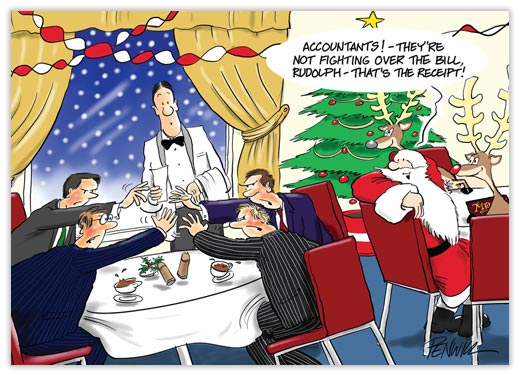
A little holiday accounting humor….
How to Get the Most Out of LinkedIn During Your Job Search Written by Alan Carniol

Learn how to take the strategic approach to LinkedIn and let it work to your advantage.
Joining the site, setting up your profile page and connecting with other contacts are not enough to help you land a job you’re interested in. You have to use LinkedIn’s basic elements in order to maximize the value of your membership (especially if you’ve chosen to go the Premium route).
Networking
It’s very easy to add contacts to your network—and you can start as soon as you join the site. Accepting and sending invitations to connect can be addicting. Be willing to connect with professionals outside of your existing network to build connections related to your fields of expertise and interest. (You never know when someone may need you.)
Don’t randomly add people just because LinkedIn suggested them. Before connecting with someone, think about your purpose in networking with people and how you want your connections to grow over time. You can still connect with people on different social media sites, but you need to consider LinkedIn as a professional platform that can pave the way to bigger opportunities.
Forget the Numbers
The number of connections you have on your profile page doesn’t matter. Adding contacts for the sake of doing so isn’t the most effective way to leverage your career. When it comes to building your base, it’s best to take a deliberate approach and focus on selecting connections that have the potential to help you reach your career goals. Remember that quality is always better than quantity.
Focus on Potential Contacts
If you’re not sure which types of contacts will be of value to you, feel free to communicate with them upfront to find out if they are willing to network with you actively.
There’s no need to rush—take the time to vet each request you receive before accepting. Don’t be afraid to ask why they want to network with you. It’s okay to skip several connections to make way for others that are more promising for future collaborations.
Be intentional when it comes to building your network on LinkedIn. The right focus will make you a power user, and will allow you to get much more out of this professional social media platform. It may just open the doors to your next job opportunity.
HOT Accounting & Finance Openings December 2016
- Internal Financial Reporting Manager (E&P, CPA)
- Logistics Coordinator
- Senior Financial Analyst (Modeling and Hyperion Planning)
- Reporting Specialist (mini controller for 5 to 6 operating companies)
- Senior Accountant (mini Controller for 3 to 4 operating companies)
- Entry Level Audit (less than 10% travel) 0 to 1.5 years of experience
- Senior Payroll Accountant
- Senior Auditor – Public Accounting – high growth mode firm!
- Audit Manager – Public Accounting – high growth mode firm!
- Senior Property Accountant (construction experience)
- Senior Financial Analyst (Manufacturing, International & MBA)
- Internal Auditor (high travel)
- Controller – (CPA, distribution & manufacturing required, 12 to 20 years of exp)
- Budget Analyst
- Tax Accountant – NW Houston – Public Accounting
Logistics Coordinator – West – dlemaire@cfstaffing.com
CFS is seeking a logistics coordinator for a privately owned energy infrastructure company on the west side of Houston. With partners all across the US, this company is showing substantial growth and is looking to add to their logistics team immediately.
- Salary ranges from 60K-90K
- 4% 401K match
- 3 weeks PTO
Position Information
This role will facilitate logistical movements between customers, third party companies and internal customers. The coordinator will develop KPI’s, on-board new vendors, create work orders, and be the main point of contact for transportation of all fleet equipment. The coordinator will assist or directly select the vendors required based on customer demands and negotiate with vendors.
- 5+ years of experience desired
- 20-40% travel required
- Oilfield Services industry experience mandatory
- Degree optional
- Strong interpersonal skills
- Proficiency in Excel
- Strong problem solving skills
Internal Financial Reporting Manager – Galleria – dlemaire@cfstaffing.com
Position is open due to growth in 2016 and anticipated growth in 2017. Galleria location.
Job Description
- Complete monthly close entries related to DD&A, ARO, Mark to Market and various accruals
- Maintain ARO system and updates
- Calculate DD&A and Impairment
- Prepare internal quarterly and annual financial reports and footnotes
- Prepare and enter journal entries
- Account Reconciliations
- Prepare documentation and assist with annual audit
- Assist with internal control compliance
- Research new US GAAP requirements and implement as needed
- Bank Reconciliations
- Assist with expenditure accounting
- Write system reports
- Work with Fund Administrator
- Maintain Chart of Accounts
- Special Projects
Requirements:
- CPA
- Public Accounting Experience – 3+ years plus (preferred, but not required)
- Oil and Gas Accounting Experience specifically related to financial reporting and monthly/quarterly close
- 5+ years
- Experience with Accounting Research
- Advanced Excel
Crude Oil and Commodity Prices 12/14/2016
Crude Oil and Commodity Prices
December, Wednesday 14 2016 – 08:08:15
|
|
||||||||||||||||||||||||||||||||||||||||
|
|||||||||||||||||||||||||||||||||||||||||



 0.15 0.28%
 The Most Frustrating Thing Candidates Get Wrong When They Interview – By Ben Whit
I have always say it is (most often) not the one with the best skill set who gets the job, its the one who is most prepared!!!!

I have spent the majority of the last seven years of my life working in talent acquisition. I have worked for two fortune 500 companies in that time, once as a head hunter and once as a corporate recruiter. I have looked at thousands of resumes for many different roles. I have also interviewed thousands of candidates over the last 6+ years. Truthfully, I have been blown away by some candidates whilist others left quite a bit to be desired. Usually it doesn’t take long for a seasoned recruiter to tell whether a candidate is going to be a rock star or the opposite. Now some of that decision making process happens before you even pick up the phone. The recruiter looks at your resume and can tell if someone is going to have the necessary skills.
In all honesty there have been times where I looked at a resume and based on the conversation with my hiring manager, felt as if my conversation was all but a formality. There have been times where I literally thought to myself, I am going to have this conversation and as long as the person doesn’t say something appalling or offensive I will most likely be sharing them with the hiring manager as soon as I can type up a paragraph and hit send. Now to some of you that might be a little disheartening. You might be thinking, “well Ben, if your mind is already made up what is the point of me even showing up for this interview?”Fair question but I would counter that by saying that despite what opinions may be formed prior to the conversation taking place, you still have the power to change the recruiter’s opinion of you. But how?
The One Thing That Differentiates The Best Candidates
Well I am glad you asked, this brings me to the most frustrating thing candidates get wrong when they interview. The one thing that differentiates the best candidates from the candidates who don’t make it past the first round is preparation. There is a noticeable difference between those candidates who sound prepared and those who sound like they are really winging it. If you want to place yourself amongst those who excel during interviews then the key is to control what you can control, which is your level of preparation. Many times I have gotten into a conversation with someone only to find out very quickly they were woefully unprepared to speak with me. I can tell you for a recruiter that is a very frustrating thing to deal with. When someone comes into an interview unprepared like this, it tells the recruiter that not only do they not value your time but they also don’t value the opportunity.
Now if you care about an opportunity those are thing you obviously don’t want your recruiter thinking. So these are three basic things you need to know about the company when you’re going into an interview (Oh, by the way, check out this link and you can download my free interview prep guide so that you are full on ready for your interview):
- Have a solid foundation of knowledge around what they do, how they are doing as an organization and knowledge of their history.
Look, this is the easy stuff. If you are interviewing with a company, you owe it to yourself to have this information. Anyone with access to a computer can easily get all this information, commit a good deal of it to memory and go into an interview relatively prepared. What I like to do is write down the information I want to know on a piece of paper and once I find that information, I write it down on the piece of paper under the question. The fact of the matter is you remember things better when you write them down. Just reading it won’t always be enough.
- Know the job description and be able to speak to where your prior roles have overlapped.
Not being extremely familiar with a job description can also be a huge mistake. If I am on a phone interview I like to have a tab open with that information right on the screen in front of me. Pro-tip: copy and paste it into Word, leave a few lines of space between the must haves and then write how you meet those requirements in the blank space. That way if you talk about the role you will be well prepared to address this topic.
- Be prepared to answer the questions you know are coming.
The fact of the matter is you know several questions you are going to be asked already. They are going to ask you why you are looking. They are going to ask you what you like about the job you applied to. They are going to ask you how much money you make or how much you are looking for or both. Any recruiter worth their salt will in some way or other ask these questions. Since you know they are coming it would be crazy for you not to be prepared to answer them. On my website, I have posts on how you can answer each of these questions.
Final Remarks
Well there you have it. Don’t be one of those candidates who just assumes they will be able to win over their interviewer with their wit and charming personality. Control what you can control and come to that interview ready to kick butt and make a name for yourself. In today’s competitive job market you might find yourself going head to head with candidates who are just as qualified as you.
Ultimately, more than you know, it comes down to who did that little bit extra and was prepared. I have had people tell me that they don’t want to prepare because they want to like them for them and not just what they prepared and said during the interview. While I understand that sentiment; but I would counter with this – in my opinion, you always want to be the one making the decision. If they give you an offer and you don’t want to make the move you can always say no. But it’s much better to be in the position to make that decision, as opposed to the other way around. Thanks for reading and I hope this helps!
Purchasing Manager Index – November 2016
Still above 50!
The Houston Purchasing Managers Index (PMI), a short-term leading indicator for regional production, registered 50.5 in November, signaling economic expansion in metro Houston for the second consecutive month, according to the latest report from the Institute for Supply Management-Houston (ISM-Houston). The November reading is down slightly from 51.1 in October, which broke a streak of 21 straight months in which the index signaled contraction.
Click to access Purchasing_Managers_Index.pdf
7 Questions To Ask At Your Next Job Interview By Ben Rosen

What is the most important goal that needs to be accomplished in the first 60 days in this role?
Asking this question shows that you focus on the most essential tasks when working, and care about meeting targets – it also tells you what to focus your efforts on if you get the job.
What are some of the challenges that will face the person filling this position?
This shows that you face challenges head on, you don’t avoid them. It also tells you what challenges you will face if you get the role, which will help you perform well and achieve KPIs.
What are your company’s values?
Their answer will tell you whether this is a company that matches your values, and therefore whether you would enjoy working there or not. It may also give you an idea of whether the company just talks about their values, or actually lives by them. And of course asking this shows that you care about company values.
How would you describe your management style and company culture?
If your interviewer will become your boss, knowing his/her management style is very helpful; it tells you how to communicate and work under them. The culture the company has will affect your enjoyment of the role as much as the role itself, so it’s important to get a feel for it in the interview. Good company culture makes work life engaging, with possibilities for collaboration and growth. But working in a disempowering environment will make you want to leave the job.
Can you tell me what the team I’d be working with is like?
Sometimes a company’s culture can be less than perfect, but your team’s culture could still rock. Asking about the culture of your team tells you more specifically what kind of work environment you would be in.
Do you have any feedback for me, or hesitations to hiring me that I can address at this stage?
This question is brilliant because it’s gutsy. It shows you’re confident enough in your skills and abilities to discuss your vulnerabilities openly. It also show that you like to be coached, which is a very attractive trait to employers.
What is the next step now?
Only ask this if, based on their answers to your previous questions, you want to work at this company. If you do want the job, asking what the next step is is essential. It shows that you’re keen to be hired and want to know what happens next.
Senior JIB Accountant – Houston – dlemaire@cfstaffing.com

Job Duties:
- Payout Accounting (Co. operated and Outside operated)
- Well Count I Allocations
- Overhead (Producing,Drilling, Major Construction, P&A)
- Land Interface of Rental payment & expense booking
- SWD Billing and/or Re-class of expenses
- Property Reverse & Re-book
- Use of Council of Petroleum Accountants Society (COPAS) guidelines to determine overhead eligibility (P&A,D&C, recompletions/workovers)
- Record monthly General Liability & Access Liability Insurance
- General ledger account reconciliations
- Journal vouchers
- DOI/JBS deck maintenance
- Support Monthly JIB Close
Qualifications:
- College degree and/or equivalent experience
- Five to ten years of joint interest accounting experience with onshore oil & gas properties
- Knowledge and understanding of COPAS documents
- Good communication and interpersonal skills to interface effectively with management, land and production departments
- Working knowledge of Joint Operating, Unit agreements, and Force Pooled wells
- Comprehension and understanding of daily drilling reports
- Working knowledge of the various departmental activities in an upstream E&P company and their interface/integration with the Accounting department
View original post 7 more words
Entry Level – Internal Audit – Woodlands
Job Description:
Review and appraise the soundness, adequacy and application of financial and other operation controls to ensure effective control at reasonable costs.
Ascertain the extent of compliance with established policies, procedures and business practices to ensure effective operations.
Partner with audit clients to identify constructive and value-added solutions to address issues identified.
Recommend operation improvements which ensure that proper controls are exercised over all aspects of the business and that company assets are conserved, protected and accurately reflected.
Assist in the preparation and presentation of audit results and strive to improve their communication to appropriate management levels to maximize the value of audit services.
Appraise the quality of performance of audited groups in carrying out their assigned responsibilities to ensure a proper balance of controls to risks, which removes unnecessary complexity, and adopts cost effective measures.
Consult with business clients to redesign/re-engineer…
View original post 45 more words
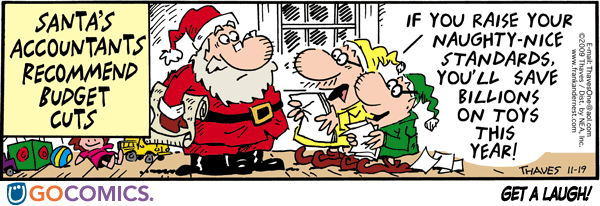
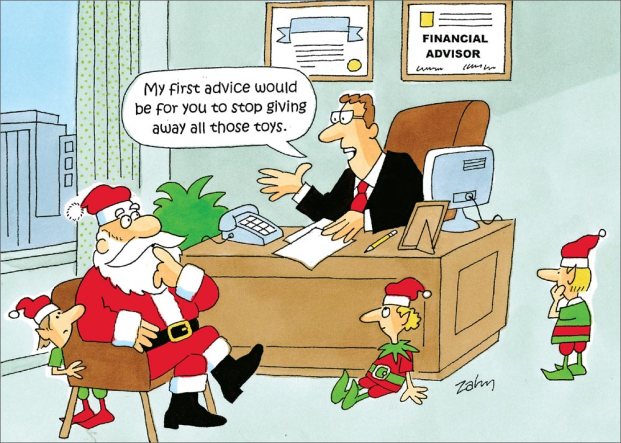
Friday Accounting Fun!

Entry Level – Internal Audit – Woodlands
Job Description:
Review and appraise the soundness, adequacy and application of financial and other operation controls to ensure effective control at reasonable costs.
Ascertain the extent of compliance with established policies, procedures and business practices to ensure effective operations.
Partner with audit clients to identify constructive and value-added solutions to address issues identified.
Recommend operation improvements which ensure that proper controls are exercised over all aspects of the business and that company assets are conserved, protected and accurately reflected.
Assist in the preparation and presentation of audit results and strive to improve their communication to appropriate management levels to maximize the value of audit services.
Appraise the quality of performance of audited groups in carrying out their assigned responsibilities to ensure a proper balance of controls to risks, which removes unnecessary complexity, and adopts cost effective measures.
Consult with business clients to redesign/re-engineer business processes. Identify opportunities for increasing operational efficiencies and strengthening management controls.
Qualifications:
Bachelor’s degree with a concentration in Accounting or Finance
6 months to 2 years public accounting and/or internal audit experience
Ability to travel up to 10% of the time
#wednesdaymotivation #goals #2017

Senior JIB Accountant – Houston – dlemaire@cfstaffing.com
Job Duties:
- Payout Accounting (Co. operated and Outside operated)
- Well Count I Allocations
- Overhead (Producing,Drilling, Major Construction, P&A)
- Land Interface of Rental payment & expense booking
- SWD Billing and/or Re-class of expenses
- Property Reverse & Re-book
- Use of Council of Petroleum Accountants Society (COPAS) guidelines to determine overhead eligibility (P&A,D&C, recompletions/workovers)
- Record monthly General Liability & Access Liability Insurance
- General ledger account reconciliations
- Journal vouchers
- DOI/JBS deck maintenance
- Support Monthly JIB Close
Qualifications:
- College degree and/or equivalent experience
- Five to ten years of joint interest accounting experience with onshore oil & gas properties
- Knowledge and understanding of COPAS documents
- Good communication and interpersonal skills to interface effectively with management, land and production departments
- Working knowledge of Joint Operating, Unit agreements, and Force Pooled wells
- Comprehension and understanding of daily drilling reports
- Working knowledge of the various departmental activities in an upstream E&P company and their interface/integration with the Accounting department
- Proficient in Microsoft Excel,Access and Outlook applications
December Newsletter for Accounting & Finance Professionals in Houston
Industry News and Updates
This will be my last newsletter of 2016! I recently attended a symposium sponsored by the Institute of Regional Forecasting – University of Houston, Bauer College of Business (Go Coogs!). I have shared the information I learned with you below. While I’ve inserted some of my opinions, I can’t take any credit for this. This information was presented by Robert Gilmer, Ph.D.
- Houston (more than likely) hit a mild recession the end of 2015 / beginning of 2016.
- Houston is not going to enjoy a V shaped recovery. This will be a very slow recovery for us.
- We lost about 80,000 oil related jobs (these jobs also impacted other industries as it trickles down).
- In the past 21 months we have added 26,300 jobs. In 2016, we added 5,600 (this could be revised downwards).
- Most of the jobs created in the past 21 months were related to the drop in natural gas prices and the petrochemical construction boom on the east side of Houston.
- The worst SHOULD be behind us.
- Oil has almost doubled in price since January!
- Overall demand for oil globally is still growing (slowly), but there is still too much supply.
- Oil needs to be at 60 dollars or above outside of the Permian Basin. The Permian Basin can make a profit at 45 dollars a barrel. This is where the rig count has grown by 150 rigs!
- Jobs come back 2 quarters after rig count goes up.
- There are 3 likely scenarios for 2017. Highly optimistic: Jobs come back Q1; Somewhat optimistic: Jobs come back Q2; Not very optimistic: Jobs come back the end of 2017. In my opinion we will see a steady pick up over the year.
- No matter what: 2018 and 2019 should be great years for Houston!
Please feel free to email me any questions about this data. I know it’s a lot to take in. I do believe that we are starting to make the turnaround. The key indicator to me is that positions with oil & gas companies are starting to be replaced when someone leaves. That also means that other companies are hiring them away. I am very optimistic about 2017 and definitely think we have put the worst behind us.
Have a great holiday! See you next year!
Local Statistics:
- National Unemployment Rate: 4.7 (last year 4.9)
- Houston Unemployment Rate: 5.1 (last year 4.7)
- Labor Participation Rate: 62.8% (last year 62.50%) – All time high January 2000: 67.30% / All-time low 1977: 62.4%
- Manufacturing Index: 51.5 (last year 48) – from what I have read 50 is the magic number! YES!!!!!
- Oil Rig Count: 580 (last year 760) – all time high around 1900 in 2012!
- Price of Oil: 51.06 (last year around 50.90)
- Industries hiring: Retail, Manufacturing, Limited Oil & Gas is coming back, Non Profit, Public Accounting Firms!!!!
- Positions in demand: Audit & Tax Public Accounting SUPER HOT!, Staff Accountant, Internal Audit, SEC or Big 4 backgrounds are in high demand
Interesting Articles:
- The follow-up email that works even better than “Just Checking In”: http://wp.me/puDjI-1yk
- Handling the impossible question: what are your weaknesses? http://wp.me/puDjI-1yD
- Why the color of your suit matters: http://wp.me/puDjI-1xQ
- Interview Preparation Checklist: https://dianedelgadolemaire.com/short-interview-preparation-checklist/
Current list of openings:
- Spanish Speaking Staff Accountant – SW
- Budget Analyst – SW
- Senior JIB Accountant – NW Houston
- Director of Compensation – Katy
- Senior Financial Analyst – Galleria
- Senior Property Accountant – Galleria
- Senior Financial Reporting Specialist – North
- Controller for small/midsize Company- CFO track – Humble
- Senior Accounting Analyst – Special Projects – 3 to 4 years of public accounting – Southwest
- Audit Manager – Public Accounting – Growing firm!!!!!
- Rotational Audit Role – International Travel – Big 4 Background – Galleria
- Senior Treasury Analyst – DT – Big 4 or Large Regional Firm background
- Operational Auditor – Westchase
- Senior Payroll Accountant – SW
- Senior and Staff Investment Analyst – Investment banking experience
- Senior Financial Analyst – North Houston
- Reduced work week hours: Tax Manager or Supervisor or Senior – small public accounting firm
- Consultant with professional services firm – Big 4 Auditors – Downtown
- Senior Internal Auditor – Northwest
- Financial Reporting Accountant – West & Downtown
- Staff Internal Auditor – Galleria
- Tax Staff Accountant – Galleria
- Tax Senior Accountant – High Net Wealth
- Staff Auditor – Public Accounting
- Senior Auditor – Public Accounting
- Senior Accountant – NW Houston
- Senior Insurance Accountant – NW Houston
- Staff Accountant – NW Houston
- Property Accountant Senior
- Audit Senior – 60% travel
- Associate Manager / Manager – Professional Services Firm – Consulting on high profile projects – full time role – need at least 2.5 year of public accounting and maybe a splash of industry to qualify
Diane Delgado LeMaire
Senior Managing Director, Executive Search & Branch Manager
www.linkedin.com/in/dianedelgadolemaire/
 Houston's F&A Recruiter and Talent Connector